Forward
I began to wonder if I needed an alarm clock as my body kept waking up before it rang. However, had I not set an alarm I would not have woken up: Murphy's Law.
The wind howled like it had the previous days, and the sun was nowhere to be seen. We had to make tracks today. By this time in the trip, the group as a whole had agreed to an invisible contract, and camp disassembly was efficient with very little communication needed between members. After the ropes had been prepared for travel, the group was ready to start the long vertical day. The objective was to climb to the saddle and descend the other side where we would camp and recover for the last day of uphill travel in the entire trip.
Jorn had proposed a strategy for rope team travel that would prove to work very well. Up to this point, one group would lead all day, breaking trail as well as route finding while the groups that followed would obliviously march along behind. We made it a point to stop every hour for a break but this was wasting precious time we didn't even realize was slipping through our numb fingers. The new method was for each rope team to lead for 15-20 minutes, then step aside and let the next team break trail and route find. Once each team had led for their turn, and the first group was up again, we would then have a break. This method not only increased our speed up the slope, but boosted the group's morale because we traveled a greater distance with more elevation gained than any other previous day.
The first half mile we gained about 400 feet of elevation, and finally climbed above the clouds which were being funneled into the saddle where we had spent the last few nights. On our first break, I watched the clouds travel up the valley from where we had come. I envisioned the other group having found our tracks and were making good time into the heart of the range even as we were leaving it. It had all gone by so fast.
I had it figured we would climb hard today, camp, then climb tomorrow and descend the ridge toward the evac lake, chilling there for a day before the plane picked us up. At the beginning of the trip that seemed like an unattainable goal. Now, as my hands double checked my knots out of habit, with what I guessed to be about 20 miles to go, it seemed easy. No longer does the heavy pack bother me. Besides everyday that we ate, the pack grew lighter. Three more days, a day of modern travel back to Denver, and on the fifth day I would have a real cup of coffee at home.
An hour or so into the climb, the lead group spotted the trail from the group that had descended the previous day, and the pace doubled as no one else had to break trail or route find. During the morning, the rope teams traded the first person off so each person could have a chance to lead. Once we reached the saddle, the leaders had an important decision to make: descend to the left or right?
The group we met had ascended the right side of the crevasse field and said it would most likely be best to descend there as well. The kicker was that once we dropped into this valley the required path was on the opposite side. It was a choice between descending the easier side and then traversing the valley floor to the next ridge, or descend down the left side. The potential headache of descending down the left side could be offset by the fact that the group may never have to go all the way to the floor and instead traverse up to the next ridge. The decision was made to turn right and camp in the valley instead of potentially doubling the travel time for the day.
The rope team that I was a part of led the descent. I figured the best way down was to choose the route that I would ski. It worked. After two more lead changes we were at the base of the glacier. We took another long break and considered the options. Should we climb the ridge to our right or continue our descent and call it a day?
Nature's Revenge
Gray clouds swept over us, and out of habit, I pulled my shell pants and jacket out of my pack and put them on. I was a little warm but I would take being warm over being wet. We made good time as we traveled down the glacier. We watched as the clouds came in, hiding the path ahead. The SLOD's and Jeff scouted ahead while the rest of the group waited on a rocky safe zone. Like the beginning of a dark season of mourning, the sky began to weep, slowly and quietly at first.
We moved on into the mist, belayed off of our rocky ledge by our team members. Our instructors had directed us to be careful of our footing, and to keep the rope taut between us and the person in front of us in case of a fall.
The wind picked up and the rain increased, beating off my shell like tiny BB's and running down my body. After what seemed like forever, I decided to get my heavy gloves out. If I was going to stand and wait, I may as well be warm. This involved a process which was tedious. In order to get my gloves and jacket from my pack I had to remove my pack and hero loop, find my gloves and jacket in my pack, remove my hood which was over my helmet, take my helmet off, take my shell off, put the new jacket on, zip everything back up, put the hood back up, then fight with my gloves to get them under the sleeves, don my pack again, and re-clip the hero loop. I thought through this entire process as I stood there shivering. Once I had thought it out, and was confident that there would be no mistakes, I began the process described above.
The wind howled and the rain fell hard. I was constantly reminding myself that the longer I took to get my gloves on, the more wet I became. Slow is smooth, smooth is fast. Still the rope teams waited. Plink, plink, plink, plink... The sound of the rain on my shell almost succeeded in lulling me to sleep. It was a fight to remain awake while standing there.
The rope pulled tight and jerked my body forward. I stumbled a few paces before regaining my balance. Out of the mist, the slope dropped away in front of me to what I would guess to be over 35 degrees, about the steepness of a moderate Black diamond at a Colorado ski resort. Narrow steps had been carved down to the next rock island of safety.
Stepping slowly down, and trying to keep pace with Matt who was in the lead of the rope team I was on, while also being able to stop when he got there taxed any mental focus I had left. I belayed the following climber in, and then sat exhausted in what had become a drizzle from a light gray sky.
Next, was a small belay down to the next rock outcropping. We were held up in this because the anchor system had to be built. All of the rope teams had to secure their ropes, be lowered down the face, then re-rope and continue.
After what should have been a quick belay down, I waited at the bottom for the rest of my rope team, trying in vain to find rocks big enough to block the wind and rain. Around this time, Jeff had roped up and was leading the first team out onto the dry glacier. A few minutes after they had left, through the wind and rain, Jorn shouted instructions that the second rope was to be filled with students and to follow Jeff. We soon lost them to the mist. I reset the rope on my back to be ready for a team of three. Mandeep came down, followed by Jorn. He clipped into my rope with inhuman speed and told me to follow the steps of the other group. Nervously, I tracked onward following the tracks in front of me.
Suddenly, the other rope team materialized in front of me. They were waiting to cross a snow spot, and without a probe they felt uncomfortable doing so in case it covered a crevasse. After probing, and crossing the snow we were on a "dry" glacier; that is, a glacier with no snow just light blue ice. We scanned the horizon for Jeff's rope team but did not see them. We were too far behind them. A minute went by, and Jeff's trademark light green jacket looked black and white due to the storm, but the color pattern matched. Across the wind, we heard that we would need our crampons and should put them on now.
At this point in the trip, I had started keeping my crampons on the outside of my pack for easy access. I was glad I did because it kept me from having to dig through my pack in this weather. Ten minutes rolled by as we geared up. After both rope teams had their crampons on, we started slowly toward the tail of Jeff's rope. We were instructed to follow close behind so we could see the correct path and not stray. This proved to be difficult because not only were we walking in 2 inch spikes (only our second day in them) but we also had to manage our steps and keep the ropes tight as there were crevasses all around us.
Camp
After failed crampon bindings and many stumbles, we reached the edge of the glacier and took a quick break. I'm sure it was close to ten minutes but it felt shorter than that at the time. I was tired. Very tired. My stomach was hurting, and I had to force my mind to focus. The teams packed up the ropes and the Instructors led onward. First out, Jorn searched for some place to set up shelter. Another five minute quick-march and we eyed a potential camping site. Jorn felt it was too close to the cliffs. No sooner had he voiced that opinion, and a rock slide wiped out the site in question. We moved on. A hundred yards further there was a similar spot with a large rock ridge between us and the ridge. The Instructors double checked the spot before the group went up.
On the way, Jeff asked how I was doing. I responded sarcastically but in a joking tone. He nodded and told me to keep Grant awake and warm. Shrugging off my pack, I went to find Grant. He did not look well. He was off by himself, rocking back and forth while sitting on his pack. I asked him how he was doing, His eyes drifted in my direction but never focused. Something was NOT right. Gently grabbing his shoulder, I stood him up and had him swing his arms in a more intense version of the 'Warm Dance'. Asking again how he felt, he quickly mumbled quickly a soft word. "Cold", and his eyes drifted closed. "Keep moving," I said with gentle sternness, doing the moves with him so he only had to mirror my actions.
I tried to keep sleep from overtaking Grant. I watched in amazement, and with a small sense of pride, as the rest of the group set up and storm-proofed camp in less than ten minutes. As soon as the first tent was up, a dry sleeping bag was donated by Matt, and Grant crawled inside. Sitting inside the tent's covered side I looked at Grant and realized he was soaked to the bone. And here I thought my day was bad. Grant removed anything that was wet, and crawled into the dry bag, shivering.
Nick stuck his head in and asked Grant if he would like some tea or cocoa. "Cocoa." Rummaging through Grant's pack, we pulled out any clothing that was dry and handed them too him. Nick came back a few minutes later and gave Grant his hot drink.
Soon after, I headed off to my tent. After checking the stakes one last time, I shed my wet gear and began to settle in for the night. I reached into the bottom of my pack for my sleeping bag and my heart all but stopped. My bag was soaked. All thoughts of a warm night became brittle and and hollow. My fleece was wet too! My mind was broken. It started as such a good day and ended so poorly.
After a few minutes of self-indulged depression, I started to scheme how to get my equipment dry. The answer was unpleasant. My synthetic gear would best dry when exposed to heat. The logical solution was to apply heat, and at the time, the hottest thing that could be applied was the heat from my body. In other words, to have warm and dry equipment, I would have to wear the damp synthetic jacket, the wet fleece, and be inside the wet bag so my body heat could do it's job.
The wet jacket had sat on top of the wet fleece inside of my wet bag. I hoped my heat would radiate through the layers and dry everything by morning. I did have one piece of good luck and that was that somehow through it all, my winter hat stayed dry. I pulled it down as low as possible, and with my head buried in my hands, I tried to relax.
Sleep came only after my mind shut down from the cold and exhaustion. The next morning, I awoke with the wind and rain beating a somber cadence on my tent. I shuddered at the memories from yesterday and was disappointed, but not surprised, that my gear was not dry; damp but no longer wet. While breathing into my hands to try and warm them, my eyes lazily focused on the gloves and socks hanging above me. I was amused as I thought of a baby mobile doing the same job above a crib.
The other members of the group talked quietly over the sound of the storm outside and I overheard something startling. In my state of self-preservation, I had somehow missed that Grant had fallen into a crevasse. A single misstep, and he fell backwards, getting soaked by the running water from the glacier. What I had assumed was lack of energy was actually the first stages of hypothermia. I hoped he would be okay.
Laying there numb to the cold, I thought back over the last 24 hours and marveled at the day as a whole: how everything was going right, then went wrong just as quickly. Yet the thing that stood out the most was the set-up of camp. During the last hour of our day everything clicked. Each member did their part regardless of the rope team they were in. The first tent, rain-fly, and stakes that were out were assembled into a tent regardless of whose they were. Nick was on top of helping Grant by assembling a stove, lighting it in a storm, and boiling water for Grant's hot drink. He put himself and his needs on hold to take care of Grant, and by extension, the team. Everyone helped in their own way and it all came together when it needed. We had survived our trial by fire.
Four more days before we were going home. The easiness from yesterday was replaced with suspicion as the gray sky grew lighter. I lay there wondering if the next time I'd have dry bedding would be my hotel bed.
Z
Monday, April 3, 2017

Friday, March 10, 2017
Waddington Trip Report; Part 5; Grinding of the Gears; Part 2
Summit Day
We reached camp by 1700, cutting our travel time down to an hour and a half. At our CHAI meeting that evening, we went over the route for the peak ascent. It sounded like it would be about a six mile round trip. We were to bring layers for a day and a 'lunch'. With plans laid, we made dinner and crashed early. We would have a morning start time of 0430 in an attempt to climb one of the surrounding peaks. Time to get to bed.
The sky was so clear when we woke up! Someone had made a bowl that's edges were surrounded by mountains, and stretched over their top was a dark blue/black canvas. A gentle yellow glow illuminated the western edge of the bowl, and an inky blackness with bright pin pricks of stars could be seen in the east. It was beautiful.
Soon we were off, making good time across the two mile glacier that lay between us and the mountain. Most of the previous glacier time on this trip had been spent spent looking at my feet marching to whatever pace was being set, placing my boots in the impressions that were left from the person in front of me. This morning, there were no boot prints. The five inch layer of snow that had slowed our pace on previous days was still frozen with no tracks being made. We covered two miles in just over 40 minutes.
We took a break at the bottom of the mountain and looked up at the last mile before the summit. The elevation gain tripped for the remaining of the climb. Mandeep's team led, with Mandeep kicking steps into the firm snow and working his way up. During our time in S'whack Academy, our boots were heavy weights which were cumbersome and slowed us down. Now, they were tools to kick steps into the snow, their defined edges allowing us to break the surface of where we traveled.
The ideal step was called a bucket step. One would stand perpendicular to the hill and kick as hard as possible, sinking the boot just past the arch and compressing the snow, creating a step. Another form was called edging, where the climber would stand parallel to the face and kick the boot into the snow, sinking the uphill side of the boot into the surface, ideally setting the uphill half of the boot in the snow.
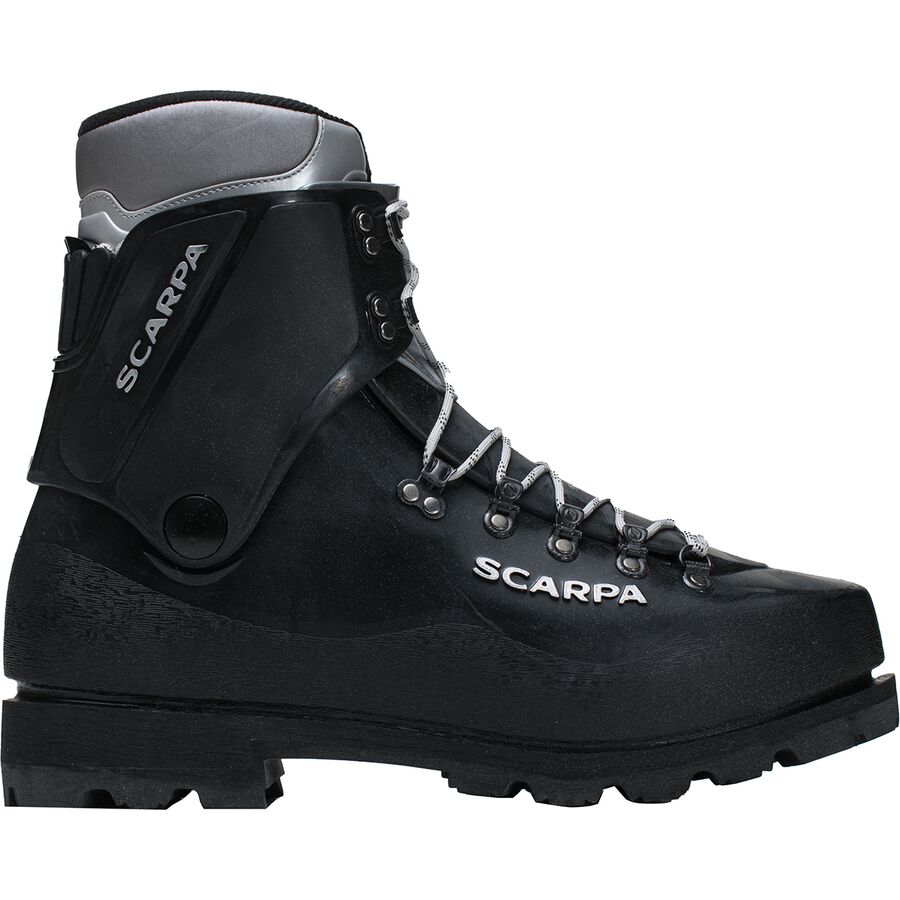
These boots are monsters; weighing in at 2.5 lbs per boot, a lot of weight on your foot. Inside is a foam liner that slides into the hard plastic shell. For a comparison, these were just a bit lighter than a modern ski boot.
The decision was made to call it a day because of the high exposure and avalanche risk. We loaded our packs up and off the back we went; into perfect bowls that made me miss my skis more than ever. A few hours later we had made it back to the glacier; it was just after 1000.
We were all looking forward to camp and relaxing, but we marched on toward the crevasses. Apparently, not everyone had done all three roles, so we were going back. From on the ridge, it looked like I could have thrown a frisbee and reached the crevasse field. But looks can be deceiving, and there was no way I could have thrown something three and a half miles. By the time we got there, it was just after 1300 and we were spent. I volunteered to be first to catch the fall. This time, I was the one thrown 5 feet forward before I was able to plant my ax and catch the fall. I then helped coach my team member as I held the weight of the 'fallen' climber. We returned to camp; it was 1700 and we had the rest of the evening off.
The Long March Ahead
At this point in the trip, we had learned enough that the instructors asked for volunteers to be leaders of the day. Stig and I thought it would be better to get it over with, so we were put in charge of the next day's activities. The instructors showed us our map location and where the plane was going to pick us up. We had almost complete control over what route the team would take as we determined the day's travel.
We would either go to the right of the crevasse field, or to the left, then on toward the pick-up point. By looking at the contour lines along where we wanted to go, we were able to get an idea of how long it would take to travel ground with similar traits. We learned from our summit day that travel was easier in the early morning when the sun had not yet melted the snow. By the end of tomorrow, we hoped to be at the the last major glacier, setting up the following days' leaders in an ideal position to escort us out.
Soon after we finalized our plans, Jeff approached us with the news that Matt was not feeling well and asked how we should proceed. Stig suggested we wait and see how he was doing later, no reason to shake things up at this point. Matt did not get better. In the interest of the team, Stig and I agreed to have the next be non-travel, giving Matt the best chance to recover. Jeff helped Matt, who vomited most of the night. Matt's tent group went about deep-cleaning as much of their gear as possible so they did not get sick.
Stig and I arranged for a couple of skills classes to be held so the day was not wasted. We both felt that it should be up to the team as to whether or not this counted as our day to lead, or would we get another chance tomorrow.
The group decided we could lead the following day. After a few revisions to the original plan, we decided to start at 0400 and travel for what we thought would be 6 or 7 hours. We planned to reach the last major glacier at the end of the day. Because we had moved over this terrain a handful of times already, we knew what the contours looked like and how fast we would travel. All that said, we made what turned out to be an accurate guess to the distance we covered that day.
'Bright' and early, we started our march onward, hoping to cover as much ground before 0715 when the sun would start to come up and hit the snow. We planned to travel up the same route that we had covered twice already, over a small rise, across a couple of bluffs, and drop down onto the glacier by the end of the day.
We made good time. We set up camp by 1430, having covered just under a quarter of the remaining distance from there to the evac point. At the CHAI meeting that night, we were given feedback from our fellow students and instructors. I learned more about leadership on that day than the previous five years combined. Our responsibilities ended when we passed the map and compass off to the next day's leaders. We crashed hard, knowing once again we'd have an early start time. Tomorrow's plan was to drop to the glacier and begin the ascent toward the summit of the last major obstacle of the journey: Jubilee Mountain.
After making record progress down the glacier the next morning, the leaders were in a bit of a dilemma, unsure where to take us next. The maps that we had showed glaciers running right to a large snow ramp leading into to camp. However, we found ourselves at the end of the glacier with no snow ramp in sight.
It was an hour before we started moving again. We climbed another 1000 vertical feet and crossed one more stream that was a little deeper then we thought. It didn't soak our feet too bad, and up for another hour or so, we soldiered on until we reached a flat area and set up camp. Despite the length of the past two days, in which we covered more miles than any previous week, we all felt good. Things were starting to become second nature. No longer did it take an hour to set up camp, but 20 minutes. We found our rolls and prepared them without being asked or told. We were becoming a team.
By now we knew what lay ahead of us: one large climb, followed by a larger descent. That day's leaders received feedback at the CHAI meeting. The new leaders presented us with their plan for the next and off to bed we went. Spent with plans, the next morning we'd travel up and over the second to last ridge that would take us to civilization.
Ghosts in the Night
The storm blew up and over the ridge, it's cold fingers trying to tear the tent from the surface. Out of the storm's fangs walked Jorn, in his orange jacket, leading a rope team toward safety. Instead of going toward the tents, his head swung as if looking for something, then he turned back into the mist away from camp.
That night was loud, but none of us cared. Two of our group heard noises and looked outside. They saw Jorn all roped up. He approached his tent and shook it. Mandeep looked out and made a happy sound, then disappeared back inside. The next morning there was a pleasant, energetic vibe throughout the camp; one which had not been present in a long time.
I overheard a conversation in my sleepy state and and this is when the 'dream' above occurred. In an effort to be efficient, NOLS had three Waddington Range trips planned for the summer with the same drop off and evac points for the group. The first group, WAD 68 (our trip), would be picked up by the same planes that would drop WAD 76 for their start. There was one trip between us working it's way up what we considered backward. It was their lead instructor that Grant and Nial had seen in the night. They recognized the instructors tent and said hello before leading their group down the ridge for the night.
Word quickly spread that another group had passed us in the night. We were interested to see them and hear of any news from the outside world. Our instructors warned us to not say to much about the trip ahead so we didn't spoil it for them.
It must have been truly terrifying to see a dozen different people running down the ridge still shrouded in mist, yelling at the top of their lungs; some of them physically recoiled. We asked about the basketball game Chase had wanted to know about all trip, among other things. Chase's team did in fact win. He was thrilled. It became clear that they wanted very little to do with us and we retreated up the ridge to our camp.
The SLOD's decided we were not to move that day because of the weather. We had another day to kill; turned out to be two days without movement. I caught up on sleep, dozing in and out for the next 48 hours. But we had information about the other side of the pass and hoped to find the tracks from the descending group to lead us up and over the saddle.
I thought a lot about the group we had encountered. They did not seam to have meshed like we had during our first week or so. Cliques were everywhere, and while we might have come across as a dysfunctional family, they gave a vibe of civil friction and disagreement. Our struggles had brought the group closer, but I was unsure if they would get the same result.
At CHAI, it was decided that the group would move tomorrow, just two days after the ghosts in the night. No one wanted additional stress on the group if we missed the evac for unnecessary reasons.
The red tent fabric fighting against the wind, rain, and slight. Warm Qdoba and pizza. The overwhelming urge to have coffee at all costs. The slight odor from my equipment, slipping down the dark hole into the arms of counterfeit peace...
Blinking, I looked at my watch: two minutes before my alarm rang. A curious habit I had acquired, where my body would wake me up minutes before my alarm rang. I lay there thinking that this journey would be over in a week's time; how I had waited so long for that moment, and yet, as it drew near, I was dreading it. Regardless of my feelings, I had no power over time. It slipped around our tent like the Enterprise jumping into warp, leaving crystals of herself in the past.
Knowing what I know now, I would not have slept well that night. There would be a time of testing in what we thought would be our final three days of travel. The physical battle had been won. The more sinister battle of the mind was marching toward us with the cold dawn of the next morning.
Z
We reached camp by 1700, cutting our travel time down to an hour and a half. At our CHAI meeting that evening, we went over the route for the peak ascent. It sounded like it would be about a six mile round trip. We were to bring layers for a day and a 'lunch'. With plans laid, we made dinner and crashed early. We would have a morning start time of 0430 in an attempt to climb one of the surrounding peaks. Time to get to bed.
The sky was so clear when we woke up! Someone had made a bowl that's edges were surrounded by mountains, and stretched over their top was a dark blue/black canvas. A gentle yellow glow illuminated the western edge of the bowl, and an inky blackness with bright pin pricks of stars could be seen in the east. It was beautiful.
Soon we were off, making good time across the two mile glacier that lay between us and the mountain. Most of the previous glacier time on this trip had been spent spent looking at my feet marching to whatever pace was being set, placing my boots in the impressions that were left from the person in front of me. This morning, there were no boot prints. The five inch layer of snow that had slowed our pace on previous days was still frozen with no tracks being made. We covered two miles in just over 40 minutes.
We took a break at the bottom of the mountain and looked up at the last mile before the summit. The elevation gain tripped for the remaining of the climb. Mandeep's team led, with Mandeep kicking steps into the firm snow and working his way up. During our time in S'whack Academy, our boots were heavy weights which were cumbersome and slowed us down. Now, they were tools to kick steps into the snow, their defined edges allowing us to break the surface of where we traveled.
The ideal step was called a bucket step. One would stand perpendicular to the hill and kick as hard as possible, sinking the boot just past the arch and compressing the snow, creating a step. Another form was called edging, where the climber would stand parallel to the face and kick the boot into the snow, sinking the uphill side of the boot into the surface, ideally setting the uphill half of the boot in the snow.
These boots are monsters; weighing in at 2.5 lbs per boot, a lot of weight on your foot. Inside is a foam liner that slides into the hard plastic shell. For a comparison, these were just a bit lighter than a modern ski boot.
As it turns out, in this terrain, maps are more or less just a reference. There were many times when we stood waiting for Mandeep's team to find a path through; our waiting was always rewarded. Credit to Mandeep: to my recollection, he lead almost every major face that the group encountered. Not that Jorn or Jeff couldn't have led; Mandeep just volunteered. "It be that way sometimes."
Up we kicked, making good progress. The sun started to peek over our bowl's edge. It spilled red, yellow, orange, and dark purple paint across the stretched canvas. We were soon on the saddle looking at our spoils. It was amazing. Most of the group were taking photos of the vistas, yet Jorn's camera, which he had carried the entire trip, remained in its protective case.
When asked about it, Jorn answered, "This is no different than any of the other times I've been here. It all looks the same to me." Being from Colorado, I could see how vistas could look the same, but I was never bored with the view. Jorn seemed to be bored. His reaction stunned me.
The decision was made to call it a day because of the high exposure and avalanche risk. We loaded our packs up and off the back we went; into perfect bowls that made me miss my skis more than ever. A few hours later we had made it back to the glacier; it was just after 1000.
We were all looking forward to camp and relaxing, but we marched on toward the crevasses. Apparently, not everyone had done all three roles, so we were going back. From on the ridge, it looked like I could have thrown a frisbee and reached the crevasse field. But looks can be deceiving, and there was no way I could have thrown something three and a half miles. By the time we got there, it was just after 1300 and we were spent. I volunteered to be first to catch the fall. This time, I was the one thrown 5 feet forward before I was able to plant my ax and catch the fall. I then helped coach my team member as I held the weight of the 'fallen' climber. We returned to camp; it was 1700 and we had the rest of the evening off.
The Long March Ahead
At this point in the trip, we had learned enough that the instructors asked for volunteers to be leaders of the day. Stig and I thought it would be better to get it over with, so we were put in charge of the next day's activities. The instructors showed us our map location and where the plane was going to pick us up. We had almost complete control over what route the team would take as we determined the day's travel.
We would either go to the right of the crevasse field, or to the left, then on toward the pick-up point. By looking at the contour lines along where we wanted to go, we were able to get an idea of how long it would take to travel ground with similar traits. We learned from our summit day that travel was easier in the early morning when the sun had not yet melted the snow. By the end of tomorrow, we hoped to be at the the last major glacier, setting up the following days' leaders in an ideal position to escort us out.
Soon after we finalized our plans, Jeff approached us with the news that Matt was not feeling well and asked how we should proceed. Stig suggested we wait and see how he was doing later, no reason to shake things up at this point. Matt did not get better. In the interest of the team, Stig and I agreed to have the next be non-travel, giving Matt the best chance to recover. Jeff helped Matt, who vomited most of the night. Matt's tent group went about deep-cleaning as much of their gear as possible so they did not get sick.
Stig and I arranged for a couple of skills classes to be held so the day was not wasted. We both felt that it should be up to the team as to whether or not this counted as our day to lead, or would we get another chance tomorrow.
The group decided we could lead the following day. After a few revisions to the original plan, we decided to start at 0400 and travel for what we thought would be 6 or 7 hours. We planned to reach the last major glacier at the end of the day. Because we had moved over this terrain a handful of times already, we knew what the contours looked like and how fast we would travel. All that said, we made what turned out to be an accurate guess to the distance we covered that day.
'Bright' and early, we started our march onward, hoping to cover as much ground before 0715 when the sun would start to come up and hit the snow. We planned to travel up the same route that we had covered twice already, over a small rise, across a couple of bluffs, and drop down onto the glacier by the end of the day.
We made good time. We set up camp by 1430, having covered just under a quarter of the remaining distance from there to the evac point. At the CHAI meeting that night, we were given feedback from our fellow students and instructors. I learned more about leadership on that day than the previous five years combined. Our responsibilities ended when we passed the map and compass off to the next day's leaders. We crashed hard, knowing once again we'd have an early start time. Tomorrow's plan was to drop to the glacier and begin the ascent toward the summit of the last major obstacle of the journey: Jubilee Mountain.
After making record progress down the glacier the next morning, the leaders were in a bit of a dilemma, unsure where to take us next. The maps that we had showed glaciers running right to a large snow ramp leading into to camp. However, we found ourselves at the end of the glacier with no snow ramp in sight.
It was an hour before we started moving again. We climbed another 1000 vertical feet and crossed one more stream that was a little deeper then we thought. It didn't soak our feet too bad, and up for another hour or so, we soldiered on until we reached a flat area and set up camp. Despite the length of the past two days, in which we covered more miles than any previous week, we all felt good. Things were starting to become second nature. No longer did it take an hour to set up camp, but 20 minutes. We found our rolls and prepared them without being asked or told. We were becoming a team.
By now we knew what lay ahead of us: one large climb, followed by a larger descent. That day's leaders received feedback at the CHAI meeting. The new leaders presented us with their plan for the next and off to bed we went. Spent with plans, the next morning we'd travel up and over the second to last ridge that would take us to civilization.
Ghosts in the Night
The storm blew up and over the ridge, it's cold fingers trying to tear the tent from the surface. Out of the storm's fangs walked Jorn, in his orange jacket, leading a rope team toward safety. Instead of going toward the tents, his head swung as if looking for something, then he turned back into the mist away from camp.
That night was loud, but none of us cared. Two of our group heard noises and looked outside. They saw Jorn all roped up. He approached his tent and shook it. Mandeep looked out and made a happy sound, then disappeared back inside. The next morning there was a pleasant, energetic vibe throughout the camp; one which had not been present in a long time.
I overheard a conversation in my sleepy state and and this is when the 'dream' above occurred. In an effort to be efficient, NOLS had three Waddington Range trips planned for the summer with the same drop off and evac points for the group. The first group, WAD 68 (our trip), would be picked up by the same planes that would drop WAD 76 for their start. There was one trip between us working it's way up what we considered backward. It was their lead instructor that Grant and Nial had seen in the night. They recognized the instructors tent and said hello before leading their group down the ridge for the night.
Word quickly spread that another group had passed us in the night. We were interested to see them and hear of any news from the outside world. Our instructors warned us to not say to much about the trip ahead so we didn't spoil it for them.
It must have been truly terrifying to see a dozen different people running down the ridge still shrouded in mist, yelling at the top of their lungs; some of them physically recoiled. We asked about the basketball game Chase had wanted to know about all trip, among other things. Chase's team did in fact win. He was thrilled. It became clear that they wanted very little to do with us and we retreated up the ridge to our camp.
The SLOD's decided we were not to move that day because of the weather. We had another day to kill; turned out to be two days without movement. I caught up on sleep, dozing in and out for the next 48 hours. But we had information about the other side of the pass and hoped to find the tracks from the descending group to lead us up and over the saddle.
I thought a lot about the group we had encountered. They did not seam to have meshed like we had during our first week or so. Cliques were everywhere, and while we might have come across as a dysfunctional family, they gave a vibe of civil friction and disagreement. Our struggles had brought the group closer, but I was unsure if they would get the same result.
At CHAI, it was decided that the group would move tomorrow, just two days after the ghosts in the night. No one wanted additional stress on the group if we missed the evac for unnecessary reasons.
The red tent fabric fighting against the wind, rain, and slight. Warm Qdoba and pizza. The overwhelming urge to have coffee at all costs. The slight odor from my equipment, slipping down the dark hole into the arms of counterfeit peace...
Blinking, I looked at my watch: two minutes before my alarm rang. A curious habit I had acquired, where my body would wake me up minutes before my alarm rang. I lay there thinking that this journey would be over in a week's time; how I had waited so long for that moment, and yet, as it drew near, I was dreading it. Regardless of my feelings, I had no power over time. It slipped around our tent like the Enterprise jumping into warp, leaving crystals of herself in the past.
Knowing what I know now, I would not have slept well that night. There would be a time of testing in what we thought would be our final three days of travel. The physical battle had been won. The more sinister battle of the mind was marching toward us with the cold dawn of the next morning.
Z
Sunday, November 6, 2016
Waddington Trip Report; Part 5; Grinding of the Gears; Part 1
Bliss
We had made it to the middle of the range, finally! We were on schedule for the first time since the beginning of our trip. Surrounding us were peaks with large open glaciers that separated us from everything else in the world. Our camp was on dry ground, set up on a rock outcropping that held a respectable view of the surrounding area.
The first day on site, we practiced snow anchors again, then were given a short lesson on crevasse rescue and how it was supposed to work; all in a very relaxed setting, no stress, just standing there comfortably.
During the CHAI meeting the following goals were set for us at the location: 1) summit one of the half dozen surrounding peaks; and 2) practice crevasse rescue.
It was decided to do crevasse rescue first, then attempt a peak the following day. The thought was to have an 'easy' day, come back to camp early, bed down and get a good night's sleep. This, in turn, would allow an early wake up, tag the summit, come back and crash without having to worry about the rescuing piece. Translation: work before you play.
Packs on back at 0930 the next morning with things you would need to stay warm and nothing else. What a concept, only take layers, a day pack basically. No need to strike camp, no heavy packs, just water and a few snacks and layers. Life was good. The next morning we tied into our rope teams and set off toward the crevasses.
Rope Team Travel
Moving on glaciers is an art, knowing where there are potential cracks called crevasses, where the glacier has broken because it could not handle the forces put on it, where travel will be easy, and where travel will be hard. Sometimes groups will have to cross crevasses and while there are signs and tricks to see and avoid holes, one can never be "too safe".
Any time we were on a glacier, we were roped up. Each rope had a head and a tail with a person or two in between, all tied together with a knot through the harness and then up through the "hero loop", then to the next climber. A hero loop is a piece of webbing that is tired to one of the shoulder straps of the pack. The strap has a carabiner attached to it and a rope is clipped through in order to keep the climber safe. The trick was leaving the person in front of you enough rope so they aren't pulled back, but being 'close' enough to catch them should they fall. The distance from our hero loop to where the rope touched the ground was supposed to be a ski tip away from where we were.

Progress at first was slow and rough as we were trying to find the pace that worked for everyone on the team. Out tallest member was 6'5", our shortest, just under 5'6". When the tall person took one step the shorter people would have to take two or three to keep up. The trick was to find a comfortable pace for everyone in the team. It took us a while to make that work. We traveled in rope teams for each others safety, to protect each other from falls.
Another consideration was what kind of terrain separated members of the rope teams. It was important to keep that in mind so you aren't dragging your team members uphill as you start to drop down the other side. Just like anything else it took time to master. By the last snow days, we were covering two or three times the distance we were in our first few days.
Rescue
We marched quickly toward the crevasse, unencumbered as our packs are very light. Just under 2 hours later we arrived and probed an area so we could un-rope. Jorn then asked for a couple of volunteers. By this time I had learned whatever Jorn did, I should do, if he asked for volunteers, volunteer so you don't psych yourself out watching someone else go first.
Here is what the math looks like; you have a 50m rope, one guy on each end, one in the middle, that means there is about 60ft of rope between the first and the second person. Add a couple feet of rope stretch and the total falling distance that I calculated was about 35 feet or so. That is a long way to fall, but it was made worse because I KNEW it was going to happen, It wasn't like it could happen, it WOULD happen. And in the next 5 minutes my instructors would ask me to walk off the edge.
In an imperfect world the leader 'falls' into a crevasse, the second and third team members self arrests catching the fall, then the third person builds an anchor and pulley system to haul you out. That was the theory. Chase was to go first, he just smiled and walked off the edge like it was no big deal, no scream, no yell, just silence. As soon as Chase had gone over the edge I turned to watch Nial get pulled off of his feet and fly five feet before he landed and self-arrested catching the fall. It became very real for me.
Then it was my turn.
I looked over my shoulder to encourage my team members, then started toward the edge.
"Just don't stop, just don't stop, just don't stop..." I made the mistake of looking down two paces before the edge. "Ohhhhh man, that's a long way down." Both the proverbial angel on my left shoulder and the proverbial devil on my right looked at each other and said, "Oooooh-no", then in unison told me to stop what ever that looked like. I didn't stop, because if I did I would have to go through the entire process again.
In one more pace my boots gave way beneath me and I fell. Will they catch me? I wondered, and then like a rubber band the rope bunched in front of my eyes and then was yanked taunt with a violent jerk. The rope running through the hero loop to my harness yanked me upright before my harness caught me. My pelvis wasn't snapped by the force of the fall because the hero loop pulled me upright as the rope was pulled taunt. The devil on my shoulder cursed like a sailor and the angel just nodded his agreement. That was scary! However my fall had been stopped, and there was nothing to do but hang out, and hope my heart rate would soon return to normal.
It happened about that quickly. Soon a third person had joined us in the crevasse and we waited for our respective rope teams to build the pulley system and haul us out. It was a weird experience being in the crevasse. The walls were white and icy blue. Looking below me, the wall continued for another 50 feet until the snow floor below. I noticed a dark blue and purple hole about the size of a VW Bug in the snow floor; that wasn't the floor but a thin snow bridge the covered the rest of the crevasse. My stomach turned; had my team not caught me no one would have ever seen me again.
It was rumored that Jorn had fallen into a crevasse unroped and had gotten out to climb another day. I can neither confirm nor deny the truth of that rumor but it wasn't to far fetched with how often he had been in the mountains. And so once again, the myth of Jorn grew.
So we hung. And we hung. Annnnd... we hung. Chase finally started to go up and was soon over the lip. The other fallen climber made her ascent and was up and out. I hung my legs having lost all feeling by now. Jeff popped his head over and asked how I was doing to which I responded "just fine". He said to hang tight, my team mates were working on the pulley system; it shouldn't be that much longer. My thoughts drifted as I began to ponder, wandering form topic to topic.
The rope pulled tight dragging me out of dream land and back into reality where I hung confused for the first minute or two wondering where I was. It all came rushing back, but it took a second before it did. I was pulled up three inches at a time until I reached the lip of the crevasse where I yelled at the team until they stopped pulling. During the fall, the rope had cut into the edge of the crevasse a good three feet and was being pulled directly from my harness to the anchor, in a straight line. We had been told about this before hand, and how critical it was to listen closely for the fallen climber's voice so they did not get crushed on the lip.
I clawed madly at the lip with my gloved hands trying to free myself from the edge and stand once again upon the surface. It was a struggle for a good five minutes as I dug from the bottom and Grant dug from the top. I felt good enough for the team to haul me up another few feet and so they slowly pulled watching for me to give the cut-off signal in case I became crushed during the pull if the pressure was too much, I gave the cut off and back to digging we went. Another five minutes went by and we repeated the process. Another three inches closer to the top. This was SLOW going! After resetting the pulley system, they asked if I was ready. I nodded, trying desperately to help in any way possible.
Cole, the climber pulling me out, was maybe 120 lbs and I had at least 50 lbs on him. They pulled slowly, moving the rope through the prusik knot and pulling it taut. I swung my boots into the wall of the crevasse trying to find purchase without success. Reset the pulley and go again, I swung my boots against the sidewall desperately, all they were hitting was dry powder; then a muted thump sound and my spirits soared, the snow was firm enough to let me kick in a step. I waited for them to reset the pulley and told them they were almost done, they pulled and I stood on my good leg compressing the snow beneath my boot into a solid foothold. They reset the pulley system quickly as I had relieved tension on the system by taking my own weight allowing the rope to slide through. I worked on a platform for my left foot as they did so and set my foot ready to stand up when they were ready. They pulled and I all but ran up the remaining few feet and cheered loudly for my team and that I was out.
I had been down there hanging for over an hour; I couldn't feel my legs.
Then it was my turn to haul someone out. On paper it is a very simple operation; catch the fall, build an anchor, build the pulley system, haul the climber out. I wondered as I stood as the third member of the rope team if I would have to help catch the fall or would Grant, the second in the team, catch the entire thing. Stig walked toward the edge and disappeared quicker then I thought possible. I fell on my ax waiting for force to be transferred to me to help catch the fall; Grant caught the load leaving me free to go about my way. Walking up quickly to Grant I checked to make sure that he was uninjured caused by catching the fall; he was ok. I dropped my pack beside him so he could hand me equipment as I needed it. I pulled snow anchors from his pack and lay them out in the snow. I marked an X beneath the spot that I wanted the power point of my anchor to lay, I then laid out the two pickets, snow anchors, and aligned their webbing so the ends lay on the X, then started digging the troughs to slide them into.
We had made it to the middle of the range, finally! We were on schedule for the first time since the beginning of our trip. Surrounding us were peaks with large open glaciers that separated us from everything else in the world. Our camp was on dry ground, set up on a rock outcropping that held a respectable view of the surrounding area.
The first day on site, we practiced snow anchors again, then were given a short lesson on crevasse rescue and how it was supposed to work; all in a very relaxed setting, no stress, just standing there comfortably.
During the CHAI meeting the following goals were set for us at the location: 1) summit one of the half dozen surrounding peaks; and 2) practice crevasse rescue.
It was decided to do crevasse rescue first, then attempt a peak the following day. The thought was to have an 'easy' day, come back to camp early, bed down and get a good night's sleep. This, in turn, would allow an early wake up, tag the summit, come back and crash without having to worry about the rescuing piece. Translation: work before you play.
Packs on back at 0930 the next morning with things you would need to stay warm and nothing else. What a concept, only take layers, a day pack basically. No need to strike camp, no heavy packs, just water and a few snacks and layers. Life was good. The next morning we tied into our rope teams and set off toward the crevasses.
Rope Team Travel
Moving on glaciers is an art, knowing where there are potential cracks called crevasses, where the glacier has broken because it could not handle the forces put on it, where travel will be easy, and where travel will be hard. Sometimes groups will have to cross crevasses and while there are signs and tricks to see and avoid holes, one can never be "too safe".
Any time we were on a glacier, we were roped up. Each rope had a head and a tail with a person or two in between, all tied together with a knot through the harness and then up through the "hero loop", then to the next climber. A hero loop is a piece of webbing that is tired to one of the shoulder straps of the pack. The strap has a carabiner attached to it and a rope is clipped through in order to keep the climber safe. The trick was leaving the person in front of you enough rope so they aren't pulled back, but being 'close' enough to catch them should they fall. The distance from our hero loop to where the rope touched the ground was supposed to be a ski tip away from where we were.
Progress at first was slow and rough as we were trying to find the pace that worked for everyone on the team. Out tallest member was 6'5", our shortest, just under 5'6". When the tall person took one step the shorter people would have to take two or three to keep up. The trick was to find a comfortable pace for everyone in the team. It took us a while to make that work. We traveled in rope teams for each others safety, to protect each other from falls.
Another consideration was what kind of terrain separated members of the rope teams. It was important to keep that in mind so you aren't dragging your team members uphill as you start to drop down the other side. Just like anything else it took time to master. By the last snow days, we were covering two or three times the distance we were in our first few days.
We marched quickly toward the crevasse, unencumbered as our packs are very light. Just under 2 hours later we arrived and probed an area so we could un-rope. Jorn then asked for a couple of volunteers. By this time I had learned whatever Jorn did, I should do, if he asked for volunteers, volunteer so you don't psych yourself out watching someone else go first.
Here is what the math looks like; you have a 50m rope, one guy on each end, one in the middle, that means there is about 60ft of rope between the first and the second person. Add a couple feet of rope stretch and the total falling distance that I calculated was about 35 feet or so. That is a long way to fall, but it was made worse because I KNEW it was going to happen, It wasn't like it could happen, it WOULD happen. And in the next 5 minutes my instructors would ask me to walk off the edge.
In an imperfect world the leader 'falls' into a crevasse, the second and third team members self arrests catching the fall, then the third person builds an anchor and pulley system to haul you out. That was the theory. Chase was to go first, he just smiled and walked off the edge like it was no big deal, no scream, no yell, just silence. As soon as Chase had gone over the edge I turned to watch Nial get pulled off of his feet and fly five feet before he landed and self-arrested catching the fall. It became very real for me.
Then it was my turn.
I looked over my shoulder to encourage my team members, then started toward the edge.
"Just don't stop, just don't stop, just don't stop..." I made the mistake of looking down two paces before the edge. "Ohhhhh man, that's a long way down." Both the proverbial angel on my left shoulder and the proverbial devil on my right looked at each other and said, "Oooooh-no", then in unison told me to stop what ever that looked like. I didn't stop, because if I did I would have to go through the entire process again.
In one more pace my boots gave way beneath me and I fell. Will they catch me? I wondered, and then like a rubber band the rope bunched in front of my eyes and then was yanked taunt with a violent jerk. The rope running through the hero loop to my harness yanked me upright before my harness caught me. My pelvis wasn't snapped by the force of the fall because the hero loop pulled me upright as the rope was pulled taunt. The devil on my shoulder cursed like a sailor and the angel just nodded his agreement. That was scary! However my fall had been stopped, and there was nothing to do but hang out, and hope my heart rate would soon return to normal.
It happened about that quickly. Soon a third person had joined us in the crevasse and we waited for our respective rope teams to build the pulley system and haul us out. It was a weird experience being in the crevasse. The walls were white and icy blue. Looking below me, the wall continued for another 50 feet until the snow floor below. I noticed a dark blue and purple hole about the size of a VW Bug in the snow floor; that wasn't the floor but a thin snow bridge the covered the rest of the crevasse. My stomach turned; had my team not caught me no one would have ever seen me again.
It was rumored that Jorn had fallen into a crevasse unroped and had gotten out to climb another day. I can neither confirm nor deny the truth of that rumor but it wasn't to far fetched with how often he had been in the mountains. And so once again, the myth of Jorn grew.
So we hung. And we hung. Annnnd... we hung. Chase finally started to go up and was soon over the lip. The other fallen climber made her ascent and was up and out. I hung my legs having lost all feeling by now. Jeff popped his head over and asked how I was doing to which I responded "just fine". He said to hang tight, my team mates were working on the pulley system; it shouldn't be that much longer. My thoughts drifted as I began to ponder, wandering form topic to topic.
The rope pulled tight dragging me out of dream land and back into reality where I hung confused for the first minute or two wondering where I was. It all came rushing back, but it took a second before it did. I was pulled up three inches at a time until I reached the lip of the crevasse where I yelled at the team until they stopped pulling. During the fall, the rope had cut into the edge of the crevasse a good three feet and was being pulled directly from my harness to the anchor, in a straight line. We had been told about this before hand, and how critical it was to listen closely for the fallen climber's voice so they did not get crushed on the lip.
I clawed madly at the lip with my gloved hands trying to free myself from the edge and stand once again upon the surface. It was a struggle for a good five minutes as I dug from the bottom and Grant dug from the top. I felt good enough for the team to haul me up another few feet and so they slowly pulled watching for me to give the cut-off signal in case I became crushed during the pull if the pressure was too much, I gave the cut off and back to digging we went. Another five minutes went by and we repeated the process. Another three inches closer to the top. This was SLOW going! After resetting the pulley system, they asked if I was ready. I nodded, trying desperately to help in any way possible.
Cole, the climber pulling me out, was maybe 120 lbs and I had at least 50 lbs on him. They pulled slowly, moving the rope through the prusik knot and pulling it taut. I swung my boots into the wall of the crevasse trying to find purchase without success. Reset the pulley and go again, I swung my boots against the sidewall desperately, all they were hitting was dry powder; then a muted thump sound and my spirits soared, the snow was firm enough to let me kick in a step. I waited for them to reset the pulley and told them they were almost done, they pulled and I stood on my good leg compressing the snow beneath my boot into a solid foothold. They reset the pulley system quickly as I had relieved tension on the system by taking my own weight allowing the rope to slide through. I worked on a platform for my left foot as they did so and set my foot ready to stand up when they were ready. They pulled and I all but ran up the remaining few feet and cheered loudly for my team and that I was out.
I had been down there hanging for over an hour; I couldn't feel my legs.
Then it was my turn to haul someone out. On paper it is a very simple operation; catch the fall, build an anchor, build the pulley system, haul the climber out. I wondered as I stood as the third member of the rope team if I would have to help catch the fall or would Grant, the second in the team, catch the entire thing. Stig walked toward the edge and disappeared quicker then I thought possible. I fell on my ax waiting for force to be transferred to me to help catch the fall; Grant caught the load leaving me free to go about my way. Walking up quickly to Grant I checked to make sure that he was uninjured caused by catching the fall; he was ok. I dropped my pack beside him so he could hand me equipment as I needed it. I pulled snow anchors from his pack and lay them out in the snow. I marked an X beneath the spot that I wanted the power point of my anchor to lay, I then laid out the two pickets, snow anchors, and aligned their webbing so the ends lay on the X, then started digging the troughs to slide them into.
This is a lot of work. We were instructed to dig to a depth that would allow us to put our arm down the pit from finger tips to elbows. It took me 20 minutes to set the two pickets and build the point. Making the exercise as realistic as possible we were wearing the layers we would be wearing out on a normal day. By the time I had the anchor built, I was in my hiking pants and my t-shirt. My hat was pulled off in an attempt to keep my glasses from fogging over; it was work.
After the power-point was constructed the next step was to take Grant out of the system, transferring weight to the anchor and off of Grant. Taking one of my prusik cords from my harness, I tied an eight on a bight, then attached this to the rope just below my power-point and clipped the eight through the carabiner. After double checking my work, I had Grant lean forward, loading the prusik and transfering Stig's weight to the anchor. Belaying myself out to the edge, I asked Stig if he was okay. He was, I informed him of the progress I had made. I then attached another prusik to the rope closer to the edge and clipped a carabiner to that. I then ran the tail from Grant's end above the anchor to the carabiner and back, creating the pulley system I would need to haul up Stig. I had Grant hold the prusik beneath the anchor so I could pull the rope through system and then have the knot catch the rope when I needed allowing the rope to only go one way. After that had been checked, I took my backpack as far out to the edge as I dared and muscled it beneath the rope so that the rope would float on the surface of the snow and not cut deeper. I informed Stig I was going to haul him out soon to which he gave me thumbs-up. All of this work, and the hard part hadn't even started. I pulled with all of my might and barely moved the rope. I struggled onward and pulled and pulled finally making progress. I then had to reset the prusiks and do the entire thing again. The next two pulls I had help from four or five other team members, and we quickly had Stig just beneath the lip. I started digging carefully with the shovel to free Stig from the lip. A few more pulls and he was up and moving. I was exhausted. It was the most real part of the trip for me.
Most of the group had done all three roles; lead, second, and third. We packed up and started back to camp and were back in out tents in just over an hour. I looked at my watch: it read 1502. I was more exhausted than I had been on the entire trip. I was worn out physically and mentally. The group meeting wasn't until after dinner and I was able to rest until that time. I drifted off to sleep in as few layers as possible. The sun was out and hot, and the warmth felt good.
Tomorrow will be a big day. but with light packs, I could really get used to this lifestyle.
Z
Thursday, October 27, 2016
The Chair Lift Haunting
Outside Magazine
Response
The article published in Outside Online concerning the safety of the chair lifts of our nation could unsettle those
unfamiliar with the ski industry and their practices. The ski industry is in
the business of moving people, primarily uphill, through the use of ropeways.
The age of the ropeway systems in the United
States is growing older and the lifts continue to run each season receiving
maintenance when required. Because ropeways have a predetermined life span, it
is logical to assume resorts will use their lifts until it becomes more efficient
to replace the lift instead of repair it. Because of the number of lifts in the
country, it is reasonable to assume regular maintenance checks will eventually
miss something that will in time cause the lift to fail. For example, on March
21, 2015 a chair lift at Sugarloaf lost traction and rolled back. It was
eventually stopped by the emergency brake, the “gear appears to have failed
some time before the March incident but went unnoticed” (“Borrell”). Ski areas
may not be aware of issues until the lift fails; it is most likely more
dangerous driving to the resort than it is riding the lifts. Since 1973,
“13 deaths and 73 injuries resulting from 10 lift malfunctions in the
United States” (“Borrell”) have been recorded. More importantly the industry
“has not experienced a fatality resulting from a lift malfunction since 1993, a
23 year period” (“NSAA”). This indicates the industry made improvements in
ropeway safety; the article only mentioned the death in 1993 and then redirects
focus to the lack of national lift safety and maintenance requirements, quickly glazing over this
achievement.
Cal OSHA regulates tramways in California and
oversaw the data at the location of the last fatality and does not share data
bases with the NSAA. NSAA could not have been known about the incident at the
time Outside Magazine contacted them about the March 1993 incident. In addition
to not sharing databases with NSAA, Cal OSHA withholds “nearly all information
about accidents, injuries and safety practices from the public and the
government” according to an executive summary about the 2012/2013 ski season,
which explains why NSAA would be unaware of the latest fatality and would have
been unable to record it for their records.
It is unclear how “local resort” is defined by
Outside Magazine defined, is a local resort the resort you go to the most
often, acreage that is available to ski, or the distance from the skier to the
resort? If “local” is defined by the skiable acreage of a resort, then Snow
Trails, OH might fall into the “local” category with only 80 skiable acres
(“Trails”) as compared to Vail Mountain’s 5,289 skiable acres (“Vail”). It
would be illogical to define local by how many miles must be driven to reach
the resort because what some consider close, others consider a road trip; the
author is very vague about how local is defined. In conclusion, the article
published by Outside Magazine sheds light on what could become an issue for the
ski industry should it be left un-addressed, however the data does not support
the ‘death trap’ concept suggested by the author.
NSAA records are availabe to the public and can
be accessed through their website, https://www.nsaa.org/,
as well as the fact sheet that was used as a reference for this response (see
NSAA 1). See Cal OSHA below for tramway regulations in place as of October
2016.
The following content is a letter that was sent from NSAA to Outside Magazine after the article was posted.
NSAA Open Letter on Outside Magazine Chairlift Safety Article
The ski industry has serious concerns with Outside’s recent article “Is Your Local Chairlift a
Death Trap?” The exaggerated, sensational tone, the significant errors—and especially the
critical omissions—are far beneath Outside’s typical standards of excellence. Look no further
than the choice of the lurid graphic of skeletons—yes, skeletons—riding a chairlift to appreciate
that Outside’s true goal here was more click-bait than objective analysis. The article is a
disservice to the ski industry as well as Outside’s readership.
Here are the facts. There is no transportation system as safely operated, with so few injuries
and fatalities, as the uphill transportation provided by chairlifts at ski resorts in the U.S. To put
things in perspective, a passenger is five times more likely to suffer a fatality riding an elevator
than a ski lift, and eight times more likely to suffer a fatality riding in a car than on a ski lift. Ski
areas have responsibly invested almost half a billion dollars in lift replacements, upgrades and
maintenance over the past 10 years.
Despite “months researching,” the article was sloppy with the facts and greatly inflated the risk
to the public of riding chairlifts at ski areas. For example, the article misleadingly highlighted
Mad River Glen’s iconic single chair (installed in 1948) as an illustration of aging lifts—when in
fact the ski area opted to entirely rebuild its famed single chair in 2007, at a much higher cost
than replacing it with a double chair, including state-of-art components and safety systems.
This mistake was particularly ironic given that the article contained a link to a source describing
exactly the great lengths taken to ensure its safety.
Outside’s lack of objectivity was underscored when the article cited Dick Penniman as a noted
authority on chairlifts—a man who has absolutely no engineering expertise on chairlifts and
extremely limited ski area operations experience otherwise. During Outside’s research on the
article, NSAA stressed to the writer that Mr. Penniman has never been a member of the ANSI
B77 committee (which is open to the public), and that in fact, the committee rejected him for
falsifying his application. Outside intentionally refused to include this critical detail, giving Mr.
Penniman a sense of credibility that is utterly undeserved on this important issue.
Contrary to the impression readers get from the article, ski area chairlifts are regulated. State
tramway authorities and the US Forest Service, through a team of tramway engineers, regulate
lift operations at ski areas. Moreover, every U.S. ski area adheres to the rigorous American
National Standard (ANS) B77.1 Standard, a national consensus safety standard followed in the
U.S. and mirrored in Canada (Z98) and Europe (CEN). The ANSI B77.1 Standard is required to
be updated every 5 years by ANSI regulation. Although the article discounts consensus
standards as “voluntary,” in fact, consensus standards are developed with input from the federal
government, industry, academia, consumer groups and other stakeholders. The federal
government relies on consensus safety standards out of necessity, and there are over 22,000 of
them in effect in the U.S.
Furthermore, there is nothing cursory about ski lift inspections. Annual inspections are
conducted pursuant to state regulations, insurance policy requirements and U.S. Forest Service
permit requirements. Additionally, ski areas conscientiously inspect their own lifts and
components daily, weekly, and throughout the entire year.
Finally, you won’t find an industry more transparent than the ski industry when it comes to
reporting safety data. There are no skeletons in our closet. NSAA annually compiles a
comprehensive report for the media and the public detailing lift incidents going back four
decades. Visit the home page of www.nsaa.org for links to in-depth data on lift safety. Neither
the elevator industry nor the amusement industry compile similar reports of their incidents. The
ski industry deserves full credit for its transparency.
In closing, the ski industry is fully committed to the safe operation of our chairlifts and we have
an exemplary track record to show for it. The ski industry deserves a more objective and truthful
treatment of this complex topic, without resort to hyperbole and sensationalism.
NSAA Open Letter on Outside Magazine Chairlift Safety Article
The ski industry has serious concerns with Outside’s recent article “Is Your Local Chairlift a
Death Trap?” The exaggerated, sensational tone, the significant errors—and especially the
critical omissions—are far beneath Outside’s typical standards of excellence. Look no further
than the choice of the lurid graphic of skeletons—yes, skeletons—riding a chairlift to appreciate
that Outside’s true goal here was more click-bait than objective analysis. The article is a
disservice to the ski industry as well as Outside’s readership.
Here are the facts. There is no transportation system as safely operated, with so few injuries
and fatalities, as the uphill transportation provided by chairlifts at ski resorts in the U.S. To put
things in perspective, a passenger is five times more likely to suffer a fatality riding an elevator
than a ski lift, and eight times more likely to suffer a fatality riding in a car than on a ski lift. Ski
areas have responsibly invested almost half a billion dollars in lift replacements, upgrades and
maintenance over the past 10 years.
Despite “months researching,” the article was sloppy with the facts and greatly inflated the risk
to the public of riding chairlifts at ski areas. For example, the article misleadingly highlighted
Mad River Glen’s iconic single chair (installed in 1948) as an illustration of aging lifts—when in
fact the ski area opted to entirely rebuild its famed single chair in 2007, at a much higher cost
than replacing it with a double chair, including state-of-art components and safety systems.
This mistake was particularly ironic given that the article contained a link to a source describing
exactly the great lengths taken to ensure its safety.
Outside’s lack of objectivity was underscored when the article cited Dick Penniman as a noted
authority on chairlifts—a man who has absolutely no engineering expertise on chairlifts and
extremely limited ski area operations experience otherwise. During Outside’s research on the
article, NSAA stressed to the writer that Mr. Penniman has never been a member of the ANSI
B77 committee (which is open to the public), and that in fact, the committee rejected him for
falsifying his application. Outside intentionally refused to include this critical detail, giving Mr.
Penniman a sense of credibility that is utterly undeserved on this important issue.
Contrary to the impression readers get from the article, ski area chairlifts are regulated. State
tramway authorities and the US Forest Service, through a team of tramway engineers, regulate
lift operations at ski areas. Moreover, every U.S. ski area adheres to the rigorous American
National Standard (ANS) B77.1 Standard, a national consensus safety standard followed in the
U.S. and mirrored in Canada (Z98) and Europe (CEN). The ANSI B77.1 Standard is required to
be updated every 5 years by ANSI regulation. Although the article discounts consensus
standards as “voluntary,” in fact, consensus standards are developed with input from the federal
government, industry, academia, consumer groups and other stakeholders. The federal
government relies on consensus safety standards out of necessity, and there are over 22,000 of
them in effect in the U.S.
Furthermore, there is nothing cursory about ski lift inspections. Annual inspections are
conducted pursuant to state regulations, insurance policy requirements and U.S. Forest Service
permit requirements. Additionally, ski areas conscientiously inspect their own lifts and
components daily, weekly, and throughout the entire year.
Finally, you won’t find an industry more transparent than the ski industry when it comes to
reporting safety data. There are no skeletons in our closet. NSAA annually compiles a
comprehensive report for the media and the public detailing lift incidents going back four
decades. Visit the home page of www.nsaa.org for links to in-depth data on lift safety. Neither
the elevator industry nor the amusement industry compile similar reports of their incidents. The
ski industry deserves full credit for its transparency.
In closing, the ski industry is fully committed to the safe operation of our chairlifts and we have
an exemplary track record to show for it. The ski industry deserves a more objective and truthful
treatment of this complex topic, without resort to hyperbole and sensationalism.
SOURCES
Borrell, Brendan.
"Is Your Local Chairlift a Death Trap?" Outside Online. N.p.,
12 Oct. 2016. Web. 27 Oct. 2016.
NSAA
NSAA 1
Cal OSHA
http://www.dir.ca.gov/dosh/aroffices.htm
Cal OSHA 2
Trails, Snow. "GET
TO KNOW SNOW TRAILS." Snow Trails. N.p., n.d. Web. 27 Oct. 2016.
"Vail Ski Resort." Wikipedia.
Wikimedia Foundation, n.d. Web. 27 Oct. 2016
Saturday, September 24, 2016
Waddington Trip Report; Part 4: Horse Shoes and Hand Grenades
Grad School
We had made it - finally - to the mountains. They were so grand. So big. Sooo much snow. And no more s'wack! As we sat in parallel parked rope teams, discussing how nice it would be to not have any more vegetation until the final days, Jorn simply shook his head and smiled. That should have been my 1st clue.
The solution to the riddle that is "Jorn" was not to be found by the Waddington 68 group despite the use of Occam's Razor. (Yeah, I know. Look it up.) Unlike the 'typical' mountain instructor who is mid-to-late 20's, single, doing what it takes to make ends meet, and has a totally biased world view, Jorn was not any of these. He was quiet. Intense. Not young. At the end of most days we held a CHAI meeting. "Community Announcements, Hot Seat, Affirmations, and Information." A popular question tossed around the circle was, 'What was the most interesting/cool thing you have done?' (One answer told the story of three students that came up from sea level and attempted a 14'er with what could have been deadly results. But it was a cool story.)
"What was the coolest thing you have done, Jorn?"
"The coolest thing that I can tell you about was the HALO jumps I did," he casually replied.
Two things stand out: HALO jump(s) and 'the coolest thing I can tell you about.'
For my non-military friends, a HALO jump is an acronym for High Altitude, Low Opening parachute jump. A plane will fly high above contested territory and drop troopers, who free fall until the last possible moment and deploy their chutes for a 'detection-less' insertion. That was the thing he could tell us about. What had he done that he couldn't talk about?
What we knew about Jorn consisted of:
And... The mystery of Jorn continues...
Second Gear
We walked through the clouds into the wonderland below. Stumbling downward, I kept my mind busy by envisioning how I would ski the slope I was on. We kept descending for a few thousand vertical feet. The contour lines grew close together until they were almost on top of each other, each black line on the map bleeding into it's neighbor. An hour and a half later and we were only half way down. The white paths of safety ended, leaving fields and gullies of loose rock and boulders. Off Jorn went, jaunting through as if he was on the way to get coffee. I blinked my frustration, admiration, and fear, hoping for the first time that my sunglasses weren't mirrored so he would understand how I felt because there was no way words were going to cut it. All he had to say about it was to stay out from under each other and keep moving, and off he went again.
This was... different.
There was no protection. No safety. If you fell, and couldn't stop, it would be game over. From within my bones I felt the cold fingers of fear leave my marrow and encase the bone. Webbing across the surface turning the white bone to a dull gray, it began to seep through the muscle pushing the pulse back until my heart had all but been encased. Fear - paralyzing fear - consumed me. I had done some pretty sketchy stuff in the mountains but nothing of this caliber. In any other circumstance I would not have gone down this way. But down we went. When we got there it was all I could do to sit still. Adrenaline was drowning my system, and it's influence continued to pump my body to believe it was not safe. But I was. Somehow, I made it down alive.
Looking back up at the drainage ditch, we saw the rest of the group at the top. One by one they start their descent, slowly, carefully. I could no longer keep Father Time at bay. Sleep was coming like a freight train loaded with coal and I closed my eyes.
My eyes flutter opened. I'd been asleep for 20 minutes already. Jorn's voice drifted through the air saying that something was wrong and that he would be back.
"Zane, packs on in 5," said a voice outside of my dark world.
"I'm up," I responded, wishing it hadn't come to that.
Off we went toward Oval Lake. Another two hours of rope team travel followed with an hour unroped. We arrived on the other side of the range realizing my dreaded enemy was back. S'wack. I might have uttered a curse word.
After a good night's rest, we battled a few hours through the alder and arrived at the lake. The welcoming committee was unwelcome: the mosquitoes had a field day. Pushing on to the next glacier we made good progress, but it not enough. Mandeep took the lead, and was moving fast. We were on the edge of a dry glacier where all of the rocks and trees had been bulldozed. It was a weird world. Everything was frozen in place. Water had melted and refroze into little beads giving our boots traction.
Our first experience with a dry glacier would not be a good one. Faster and faster we went, and then faster still. Our line had spaced out, with the front half pulling away and the second half falling farther behind. "It's only a matter of time before someone gets hurt," I thought. Nick misplaced a step and gravity took over, pulling him down the 60 degree slope. Falling six feet and landing on his shoulder, he bounced. Time slowed. I counted my heart beats, thinking that this might be my first experience with death, it can't go right. Nick's throaty yells filled my ears as he landed on his back, his pack between him and the ground some vertical feet from where he started.
He lay there moaning.
One of the students stabilized his head in case of a spinal injury. The I-team (Instructor team) quickly was there going step by step down the list to make sure Nick was ok. All other sound had stopped. Ten minutes later Nick was sitting up talking. He was shaken but not hurt. The demons came whispering out from behind the dirty ice: why was Mandeep pushing us so fast? Why didn't the other instructors say something? This was the second time in two days that we got lucky. Coming down the steep rock gully, a small boulder had been dislodged and only the student's pack, and it's size, saved him from what very likely could have been a deadly encounter. Jorn took over, making sure the group was okay, then heading onward with renewed speed.
The forced march continued until we found and probed a site to spend the night. We slept, an unfriendly tension in the air. NOLS is big on teamwork and team dynamics, more specifically how to handle conflict. The instructors had a very long meeting. It was obvious there was disagreement in the ranks. We didn't really know what happened, but from then on there was a friction that remained until late in the trip.
We stayed at that camp for a couple of days. One day we practiced building snow anchors and had a nice little rest. The sensation of time is non-existent in the back-country. You move when it makes sense to move; you bide your time when you need to wait. The next step to our journey was to traverse from one glacier up to another, then tag a pass and drop into the valley on the other side. In years past there was a steep but climbable snow ramp connecting the two. On this trip there was no ramp, just a cliff. The plan was for the group to split up into three teams, and then shuttle their way up a top roped pitch connecting the two glaciers. Packs on back time was 0300 in hopes that the water falls would have frozen over.
Tent groups were rearranged so that each tent contained a rope team, hopeful that things in the morning would go more smoothly. We didn't sleep well and the alarms went off at 0130, beginning our day. It began with a hour delay for packs on backs due to weather. Crawling back into our sleeping bags we hunkered for another 60 minutes, not wanting to go back to sleep. 0245, another delay of an hour. Packs on backs at 0500. Time moved like a melting ice-sickle, drop by slowww drop. Another hour delay pushed the start time to 0600. The red tent fabric snapped with the wind, a violent dance that lolled me to sleep until my alarm went off at 0525. Striking camp had become second nature, and we were cleaned up in record time. At the start of our trip it took us 45 minutes to go from bags to packed. By the last few days it was done in almost 15.
The first team headed off across the divide and started the climb. The rest of the group waited until the first team was on it's way up so there would be no line at the belay. We watched as they reached the climb, and stopped and waited. Jorn in his trademark orange shell jacket, and Mandeep in his blueberry colored shell, they ventured up to the left, then back to the group, and Jorn started the climb. Smooth sailing until about halfway up, where he stopped, and waited. The group at camp watched him for a solid 15 minutes. He stood there for that time, then down climbed and the rope team started to come back. No dice, the route was impassable. Upon returning we saw Jorn soaked head to toe, and the I-team had a meeting while the students talked. Story was the entire route was up a water fall, and exposed the entire way. The best case scenario was for people to climb up and everything be soaked and everyone cold. It just wasn't going to happen.
Margaret was part of the team that went up to attempt the climb; these are what she brought back.
We spent the next hour descending back to the lake where we set up camp, wondering how long we'd be there this time. It had been a long day: awake since 0130, covering 3 miles total, all in retreat. Before returning to the lake Jorn called Mama NOLS and requested instruction on what they wanted us to do next.
The next morning a team climbed the pass that we had come down 3 days prior. They wanted to try the sat phone again, which had broke, tolerance for adversity and uncertainty. So we waited. Jorn called for a meeting, and another fact about Jorn was brought to light: he was one of the higher ups at the New Zealand NOLS branch. He then explained to us what the PNW, Pacific North West NOLS branch, would be doing. It was reassuring to 'know' what was going on and to know what 'would' happen. Which boiled down to the PNW was either going to give us a new route or they would shuttle us to the next food drop in the helicopter. Day one ticked by. Then day two. By day three, we were restless. Food was running low but we didn't have to eat much because we weren't burning calories. We laid in the tents hunting the mosquitoes that entered when we did.
Day three of waiting was filled by a lesson on ice climbing on the dry glacier. Excited to be doing something, we set off toward the glacier. We never made it to the ice that day. As we set off to climb, a helicopter rose form behind a ridge and landed near our camp with instructions to shuttle the group to the next food drop.
The view from the chopper. Our maps show the entire valley to be filled with a glacier, not the tiny ribbon that you see. It should stretch from one hill to the other. I really didn't understand the magnitude of everything until we were flying.
One hour later, we were dropped in the middle of the range. An hour after that, we had set up camp and were told to sleep until the sun came up.
So we did.
Little did we know that the hardest days were ahead of us. Everything up to this point had just been a preview.
Z
We had made it - finally - to the mountains. They were so grand. So big. Sooo much snow. And no more s'wack! As we sat in parallel parked rope teams, discussing how nice it would be to not have any more vegetation until the final days, Jorn simply shook his head and smiled. That should have been my 1st clue.
The solution to the riddle that is "Jorn" was not to be found by the Waddington 68 group despite the use of Occam's Razor. (Yeah, I know. Look it up.) Unlike the 'typical' mountain instructor who is mid-to-late 20's, single, doing what it takes to make ends meet, and has a totally biased world view, Jorn was not any of these. He was quiet. Intense. Not young. At the end of most days we held a CHAI meeting. "Community Announcements, Hot Seat, Affirmations, and Information." A popular question tossed around the circle was, 'What was the most interesting/cool thing you have done?' (One answer told the story of three students that came up from sea level and attempted a 14'er with what could have been deadly results. But it was a cool story.)
"What was the coolest thing you have done, Jorn?"
"The coolest thing that I can tell you about was the HALO jumps I did," he casually replied.
Two things stand out: HALO jump(s) and 'the coolest thing I can tell you about.'
For my non-military friends, a HALO jump is an acronym for High Altitude, Low Opening parachute jump. A plane will fly high above contested territory and drop troopers, who free fall until the last possible moment and deploy their chutes for a 'detection-less' insertion. That was the thing he could tell us about. What had he done that he couldn't talk about?
What we knew about Jorn consisted of:
- He had served 20 odd years in some military, for which country we didn't know.
- He was older then 50
- He had more experience in the mountains than anyone else on the trip
And... The mystery of Jorn continues...
Second Gear
We walked through the clouds into the wonderland below. Stumbling downward, I kept my mind busy by envisioning how I would ski the slope I was on. We kept descending for a few thousand vertical feet. The contour lines grew close together until they were almost on top of each other, each black line on the map bleeding into it's neighbor. An hour and a half later and we were only half way down. The white paths of safety ended, leaving fields and gullies of loose rock and boulders. Off Jorn went, jaunting through as if he was on the way to get coffee. I blinked my frustration, admiration, and fear, hoping for the first time that my sunglasses weren't mirrored so he would understand how I felt because there was no way words were going to cut it. All he had to say about it was to stay out from under each other and keep moving, and off he went again.
This was... different.
There was no protection. No safety. If you fell, and couldn't stop, it would be game over. From within my bones I felt the cold fingers of fear leave my marrow and encase the bone. Webbing across the surface turning the white bone to a dull gray, it began to seep through the muscle pushing the pulse back until my heart had all but been encased. Fear - paralyzing fear - consumed me. I had done some pretty sketchy stuff in the mountains but nothing of this caliber. In any other circumstance I would not have gone down this way. But down we went. When we got there it was all I could do to sit still. Adrenaline was drowning my system, and it's influence continued to pump my body to believe it was not safe. But I was. Somehow, I made it down alive.
Looking back up at the drainage ditch, we saw the rest of the group at the top. One by one they start their descent, slowly, carefully. I could no longer keep Father Time at bay. Sleep was coming like a freight train loaded with coal and I closed my eyes.
My eyes flutter opened. I'd been asleep for 20 minutes already. Jorn's voice drifted through the air saying that something was wrong and that he would be back.
"Zane, packs on in 5," said a voice outside of my dark world.
"I'm up," I responded, wishing it hadn't come to that.
Off we went toward Oval Lake. Another two hours of rope team travel followed with an hour unroped. We arrived on the other side of the range realizing my dreaded enemy was back. S'wack. I might have uttered a curse word.
After a good night's rest, we battled a few hours through the alder and arrived at the lake. The welcoming committee was unwelcome: the mosquitoes had a field day. Pushing on to the next glacier we made good progress, but it not enough. Mandeep took the lead, and was moving fast. We were on the edge of a dry glacier where all of the rocks and trees had been bulldozed. It was a weird world. Everything was frozen in place. Water had melted and refroze into little beads giving our boots traction.
Our first experience with a dry glacier would not be a good one. Faster and faster we went, and then faster still. Our line had spaced out, with the front half pulling away and the second half falling farther behind. "It's only a matter of time before someone gets hurt," I thought. Nick misplaced a step and gravity took over, pulling him down the 60 degree slope. Falling six feet and landing on his shoulder, he bounced. Time slowed. I counted my heart beats, thinking that this might be my first experience with death, it can't go right. Nick's throaty yells filled my ears as he landed on his back, his pack between him and the ground some vertical feet from where he started.
He lay there moaning.
One of the students stabilized his head in case of a spinal injury. The I-team (Instructor team) quickly was there going step by step down the list to make sure Nick was ok. All other sound had stopped. Ten minutes later Nick was sitting up talking. He was shaken but not hurt. The demons came whispering out from behind the dirty ice: why was Mandeep pushing us so fast? Why didn't the other instructors say something? This was the second time in two days that we got lucky. Coming down the steep rock gully, a small boulder had been dislodged and only the student's pack, and it's size, saved him from what very likely could have been a deadly encounter. Jorn took over, making sure the group was okay, then heading onward with renewed speed.
The forced march continued until we found and probed a site to spend the night. We slept, an unfriendly tension in the air. NOLS is big on teamwork and team dynamics, more specifically how to handle conflict. The instructors had a very long meeting. It was obvious there was disagreement in the ranks. We didn't really know what happened, but from then on there was a friction that remained until late in the trip.
We stayed at that camp for a couple of days. One day we practiced building snow anchors and had a nice little rest. The sensation of time is non-existent in the back-country. You move when it makes sense to move; you bide your time when you need to wait. The next step to our journey was to traverse from one glacier up to another, then tag a pass and drop into the valley on the other side. In years past there was a steep but climbable snow ramp connecting the two. On this trip there was no ramp, just a cliff. The plan was for the group to split up into three teams, and then shuttle their way up a top roped pitch connecting the two glaciers. Packs on back time was 0300 in hopes that the water falls would have frozen over.
Tent groups were rearranged so that each tent contained a rope team, hopeful that things in the morning would go more smoothly. We didn't sleep well and the alarms went off at 0130, beginning our day. It began with a hour delay for packs on backs due to weather. Crawling back into our sleeping bags we hunkered for another 60 minutes, not wanting to go back to sleep. 0245, another delay of an hour. Packs on backs at 0500. Time moved like a melting ice-sickle, drop by slowww drop. Another hour delay pushed the start time to 0600. The red tent fabric snapped with the wind, a violent dance that lolled me to sleep until my alarm went off at 0525. Striking camp had become second nature, and we were cleaned up in record time. At the start of our trip it took us 45 minutes to go from bags to packed. By the last few days it was done in almost 15.
The first team headed off across the divide and started the climb. The rest of the group waited until the first team was on it's way up so there would be no line at the belay. We watched as they reached the climb, and stopped and waited. Jorn in his trademark orange shell jacket, and Mandeep in his blueberry colored shell, they ventured up to the left, then back to the group, and Jorn started the climb. Smooth sailing until about halfway up, where he stopped, and waited. The group at camp watched him for a solid 15 minutes. He stood there for that time, then down climbed and the rope team started to come back. No dice, the route was impassable. Upon returning we saw Jorn soaked head to toe, and the I-team had a meeting while the students talked. Story was the entire route was up a water fall, and exposed the entire way. The best case scenario was for people to climb up and everything be soaked and everyone cold. It just wasn't going to happen.
Margaret was part of the team that went up to attempt the climb; these are what she brought back.
The next morning a team climbed the pass that we had come down 3 days prior. They wanted to try the sat phone again, which had broke, tolerance for adversity and uncertainty. So we waited. Jorn called for a meeting, and another fact about Jorn was brought to light: he was one of the higher ups at the New Zealand NOLS branch. He then explained to us what the PNW, Pacific North West NOLS branch, would be doing. It was reassuring to 'know' what was going on and to know what 'would' happen. Which boiled down to the PNW was either going to give us a new route or they would shuttle us to the next food drop in the helicopter. Day one ticked by. Then day two. By day three, we were restless. Food was running low but we didn't have to eat much because we weren't burning calories. We laid in the tents hunting the mosquitoes that entered when we did.
Day three of waiting was filled by a lesson on ice climbing on the dry glacier. Excited to be doing something, we set off toward the glacier. We never made it to the ice that day. As we set off to climb, a helicopter rose form behind a ridge and landed near our camp with instructions to shuttle the group to the next food drop.
The view from the chopper. Our maps show the entire valley to be filled with a glacier, not the tiny ribbon that you see. It should stretch from one hill to the other. I really didn't understand the magnitude of everything until we were flying.
One hour later, we were dropped in the middle of the range. An hour after that, we had set up camp and were told to sleep until the sun came up.
So we did.
Little did we know that the hardest days were ahead of us. Everything up to this point had just been a preview.
Z
Tuesday, August 30, 2016
The Bear and Me; Part 1; Kobayashi Maru;
Hello Real World
That moment you realize that what you thought was a one hour class is actually a 4 hour class. Great. It couldn't be helped now, so off I went to a basic first responder lesson that would teach us how to react quickly in different scenarios to give the patient a fighting chance. It started out like I thought it would with a movie explaining what we should learn. (Four hours of this, greeeeat. **rolls eyes**) But no, our teacher, "the Bear" had something else in mind. It went from boring movie to story time. And not just story time, but to be a player in said story, cool.
We were put into groups and all but one were asked to go to the end of the hallway and await instructions. Ten minutes go by, then fifteen, and more. Finally it was my group's time. One person was directed into a side room, me and the 3rd group member were taken back to the classroom and then it dawned on me: it wasn't just story time, it was information for the game we were about to play. A game based on what we had learned so far in the class.
'Story time' had consisted of some basic information. In this case, there was supposed to have been a crew of four guys, but one didn't show up so we were down to a team of three. Company policy says that we must go places in groups of two, so two of us in the control room overseeing the production of snow, and in theory two of us to check the snow guns that would shoot the mix onto the runs.
'We' had sent one of our own guys, alone, to check the gun lines and to keep them operational. I say 'we' because the Bear had told us what 'we' did, even though it was against policy. We were supposed to have radio check-ins every 20 minutes with the guy inspecting the guns. It is 0100 and a storm is coming in shortly. The last check in was 30 minutes ago and the storm is almost on us. The question is: what do we do?
My mentality was to get our buddy back. We had a general idea of his location and we knew he had the proper equipment to weather the elements until Mountain Rescue arrived. But, he was still outside and had not contacted us. My friend and I agreed that we needed to shut down the snow making machines and call for help, and to call our supervisor and give him an update. Mountain Rescue was an hour away. The supervisor's phone went to voicemail, so we left a message.
Then came the dilemma: do we go looking for our teammate or do we wait? I said I wouldn't go, because it could make us part of the problem, and we knew Mountain Rescue was on the way. My partner wanted to go on the grounds that he had a good idea where #3 guy was, and it could be as simple as a radio issue. I asked how much longer it would take to shut the machines down. Bear said that they had already been shut down, so the ball was in my court. Company policy said that we could leave the operation room if everything was shut down (it was), and my buddy was going out looking. In the end I decided it was better to collaborate with him than let him go out alone.
Off we went to the other room where we 'found' the guys sled next to one of the pits used for snow making. Each pit is about 20 feet deep and square, and in the bottom of each pit are pipes that will sometimes freeze over causing the gun to shut down. The tool to fix this is a propane torch, similar to those used to burn weeds. We find #3 guy laying in the bottom of the pit, unresponsive, but with the torch off. (The actual 'pit' was two tables stacked on top of each other in a corner.) Looked safe. So 'down' my friend goes to check him out.
"Ok," Bear says to my buddy, "so halfway down you lose consciousness and you too are unresponsive. Zane? Now what do you do?"
In the back of my head I say to myself, 'I wanted to stay put.' But on the flip side, had I not gone, the consequences of that choice would have been all the harder. Here I was in complete control of what to do next. A propane torch in a non-ventilated concrete box, and gas had filled the pit. Stop and think. Don't make a stupid mistake. I asked if I could contact Mountain Rescue, which the answer was yes. Perfect. I 'called' them and told them where I was, and what I knew for sure, and was told to monitor the situation.
Simulation end.
Debrief
"How many of you watch Star Trek?" Bear asked.
I raised my hand, being one of a few people that did the same.
"Who has heard of the Kobayashi Maru?"
This time it was just my hand that raised. I got bonus points for that, in fact during the exercise I thought what we were doing was very similar to what Captain Kirk had done. My situation was also a no win scenario: do we deal with the thought that our buddy is in trouble and wait for help? Or do we go after him in a valiant, yet possibly suicidal, effort?
We walked back toward the classroom for the rest of the debrief. I asked what really was the best way to handle the situation. It was to call Mountain Rescue, and stay put. I then asked should I have stayed at base? Or should I have gone with my friend like I did? Bear said the choice was up to me. The machines were shut off, and he was going to go, so me going with him was also okay. As it turned out, it was a good thing that I had gone. If I had decided to stay behind, things could have gotten worse. Much worse.
"So Zane," Bear says, rehashing as we walked back into the room, "you received a check in on the radio 15 minutes ago saying that the sled had been found but that was all the info you were given. Now you have two lost guys and the weather is here. What do you do?" I inform Mountain Rescue of the recent events and tell them that my guess was that the two team members were together somewhere but both unable to communicate. Next would be an update to my supervisor (who wouldn't pick up) and I would remain where I was so that I don't make things worse. It could have played out like that. It would have gone from bad, to worse, to nightmarish... had this not been a class. But it was a valuable class. The biggest thing that we learned was to CYA. And the A's of your team. Always.
My peers looked at me differently at the end of class. They had been sitting in the room, knew what had 'happened' and watched how my and my buddy reacted to the whole thing. Bear created a healthy amount of stress that made it hard to think rationally. It felt like I had been triple sat at the restaurant in the waiting table days. I reminded my self that it was "just" a game. A game that had I not learned valuable lessons for future usage could have dire consequences.
I am looking forward to these classes now. If this is what college is like then I am really going to like it.
Z
Thursday, August 25, 2016
Waddington Trip Report; Part 3; Into the Movies
A New Pace
There are three rules of the mountains: things are always farther than they appear; things are always steeper than they appear; and things are always harder than they appear. It was time to go from the forest to the mountains, and the only way to do that was up. After getting into rope teams, we set out to climb the pass. Traveling in a rope team is therapeutic. You're still connected to your teammates and yet you are totally absorbed in your own thoughts. Just the crunch of the snow beneath your boots.
The hands of my watch spun onward. The next time I checked, the little hand had circled three times. During those three hours we kicked up toward the clouds, and the view when we crested was unbelievable. Mountains in front of us formed a majestic wall of numerous assent possibilities. The clouds hid the valley floor from us. The WHY all came rushing back to me. I had spent so many hours laboring away to get to THIS point. It all culminated in THIS moment. It was so much better than I had ever dreamed. It was... simply amazing.
The climber in me started thinking that traveling on snow was more safe than rock climbing. 'Safety' is an interesting notion because nothing is absolutely safe in the mountains. Like life, there are no guarantees. At first I was concerned that moving on snow would be less protected than climbing on rock. That's simply not the case. When tied into a rope team, each team member creates protection for the others in the event of a fall. Unlike climbing protection (helmet, rope, etc) each 'piece' of protection - each person - is moving in tandem and always looking for ways to keep the team safe.
Blinding Clarity
As we worked to master the art of trudging, my mind wandered to what we had done up to that point. It was then that a startling realization set in. When we traveled in rope teams there were times where one MUST NOT FALL. I began to understand exactly how dangerous a hobby I had chosen. Anything in the mountains has the potential to be very dangerous. There were many times on this trip where my only thought was 'this is a no fall zone'. Just that simple. Fate stepped in to underline the point.
I received a text from my climbing partner back home saying that she was pretty shaken. Having only seen her rattled once, I was very concerned and 'protect mode' kicked in. After numerous texts and a phone call, enough of the pieces were in place for me to understand. While taking a few friends climbing the previous weekend, the unthinkable happened. A rope slid through the system, dropping the climber the remaining 60 or so feet to the ground. His pelvis was broken, but no spinal injury to my partner's knowledge. The climber landed 10 feet from where my friend was standing, and she was understandably traumatized.
No one person was at fault; however both sides should have claimed responsibility for the accident. The leader for not knowing how much rope was needed for the route, and the belayer for not being aware of how much rope he had left.
After coming back from the trip where we had one evacuation and a couple of very close calls, I now have new clarity on just how dangerous the mountains can be. You have to be on your A game the entire time, from parking lot to parking lot. And a more scary thought than that is you could do everything right and it could still all go wrong. When you take someone out with whom to share your passion, you are also their protection, the resident expert. Be prepared as best you can.
Be safe out there.
Z
There are three rules of the mountains: things are always farther than they appear; things are always steeper than they appear; and things are always harder than they appear. It was time to go from the forest to the mountains, and the only way to do that was up. After getting into rope teams, we set out to climb the pass. Traveling in a rope team is therapeutic. You're still connected to your teammates and yet you are totally absorbed in your own thoughts. Just the crunch of the snow beneath your boots.
The hands of my watch spun onward. The next time I checked, the little hand had circled three times. During those three hours we kicked up toward the clouds, and the view when we crested was unbelievable. Mountains in front of us formed a majestic wall of numerous assent possibilities. The clouds hid the valley floor from us. The WHY all came rushing back to me. I had spent so many hours laboring away to get to THIS point. It all culminated in THIS moment. It was so much better than I had ever dreamed. It was... simply amazing.
The climber in me started thinking that traveling on snow was more safe than rock climbing. 'Safety' is an interesting notion because nothing is absolutely safe in the mountains. Like life, there are no guarantees. At first I was concerned that moving on snow would be less protected than climbing on rock. That's simply not the case. When tied into a rope team, each team member creates protection for the others in the event of a fall. Unlike climbing protection (helmet, rope, etc) each 'piece' of protection - each person - is moving in tandem and always looking for ways to keep the team safe.
Blinding Clarity
As we worked to master the art of trudging, my mind wandered to what we had done up to that point. It was then that a startling realization set in. When we traveled in rope teams there were times where one MUST NOT FALL. I began to understand exactly how dangerous a hobby I had chosen. Anything in the mountains has the potential to be very dangerous. There were many times on this trip where my only thought was 'this is a no fall zone'. Just that simple. Fate stepped in to underline the point.
I received a text from my climbing partner back home saying that she was pretty shaken. Having only seen her rattled once, I was very concerned and 'protect mode' kicked in. After numerous texts and a phone call, enough of the pieces were in place for me to understand. While taking a few friends climbing the previous weekend, the unthinkable happened. A rope slid through the system, dropping the climber the remaining 60 or so feet to the ground. His pelvis was broken, but no spinal injury to my partner's knowledge. The climber landed 10 feet from where my friend was standing, and she was understandably traumatized.
No one person was at fault; however both sides should have claimed responsibility for the accident. The leader for not knowing how much rope was needed for the route, and the belayer for not being aware of how much rope he had left.
After coming back from the trip where we had one evacuation and a couple of very close calls, I now have new clarity on just how dangerous the mountains can be. You have to be on your A game the entire time, from parking lot to parking lot. And a more scary thought than that is you could do everything right and it could still all go wrong. When you take someone out with whom to share your passion, you are also their protection, the resident expert. Be prepared as best you can.
Be safe out there.
Z
Subscribe to:
Posts (Atom)