The Final Ridge
It lay before us, peeking through the rainy cloud cover. This was the last ridge between us and the extraction; it would literally be all down hill from there. After a day's rest, the two new student leaders quickly outlined the plan for the next few days. Our pick up was scheduled to be in three days.
We hoped to acquire the ridge and proceed down to where we would make our last major course change toward Canyon Lake. By now our gear had dried out, and we had rationed out food for nine more meals. As you might recall from my last post, we had been given information from another NOLS Mountaineering group who recommended that we descend the left side of the glacier; the storm had push us off to the right and we ended up father down the valley then we had hoped.
Our first task was to hike back up the valley then climb up to the ridge line. The group was moving quickly due to light packs, and more importantly, the excitement that we only had a couple days more of trekking. Two more days of sore feet; two more days of lukewarm food. The conversations of the past 24 hours had quickly turned to food porn and what each member was going to do when they got back to wherever was home.
No matter how high we climbed, there seemed to be more elevation to conquer. If I recall correctly, we gained over 2000 vertical feet in under five miles of hiking. The exposure was very high, and we were on dirt and loose rocks, not snow. Our boots became crude tools and were not very effective. In time, we got high enough where there was snow and the kick stepping began. At this point, my team supplied me with occasional encouragement, as well as constant non-verbal support, as they let me set my own pace up the snow the final resting point before the top of the ridge.
At the top, the sky cleared and I spotted our descent tracks from yesterday coming down from the Jubilee Saddle, winding to and fro before stopping at the campsite of the the longest day. Sitting on my pack, I pondered eating what little of the snack food I had left. I decided against it. If I was hungry now, I would be more so later.
I wish I had gotten my head up during journey. Most of the time was spent looking at my boots and judging rope management by the slack which I saw in my peripheral. Like a DVD on replay, my boots cyclically kicked into the snow, moving my skeleton slowly upward. Once the ridge was gained, the group engaged the clutch and put it into gear, heading downhill toward civilization.
Riding the Pig
After an hour or so, and a quick break and map check, we continued without being roped in with mild aggression at the ordeal marched on until the leaders stopped abruptly at the edge of a steep snow slope; a black ski run in angle and length. A discussion unfolded as to how to get down. Standing off to the side looking down the fall line, I wished madly for my ski, dreaming about how perfect it would be to just GO. Jorn set his pack down, opened it. He donned his rain pants, and tucked his jacket into the waist band. Next, he clipped his waist belt on his pack, then mounted it like a sled and made himself comfortable. "You son of a gun," I thought, looking at the him, then at the slope. I had seen this before and attempted this very thing earlier in the journey: riding the pig.
"Riding the pig" involves a steep slope, a large pack, and a willing rider. The pack is placed upside down and the rider holds onto the clipped waist belt and proceeds to sled on the overturned pack; which is exactly what Jorn, then Jeff, then Mandeep did. I was torn between two groups: proceed to join the group of students to try and hike down, or ride the pig; I settled for something in between, skiing down in my boots. It did not go how I envisioned it. At first, I assumed I would stay on my feet skiing down in my boots. I decided to have my ice ax in hand just in case something went wrong. The first couple of 'turns' went ok, then I caught an edge and went spinning down the slope.
Doing my best to not lose my cool, I kicked my feet downhill and planted my ice ax into the snow coming to a wet stop. Now I was in a bit of a pickle. I stopped about a third of the way down the slope just before the slope was at it's steepest and thought about my choices. Do I climb back up and try to walk down, or do I commit to a wet glissade down the remaining slope? The slope was so steep I was not going to be able to get into my rain pants to keep the snow out. But not only that, I had kept my pack on, before the brilliance of the moment 100 ft ago. Meaning I could not get out of it to ride the pack down, and its fifty-ish pounds on my back. Which means I really didn't have a choice. I had to ski, glissade, and slide my way to the bottom.
Okay then!!
When I arrived at the bottom of the slope, with my pants soaked, all three instructors were smiling and having an apparent good time as they watched the rest of the group do what I had done... only they hadn't intended to do what I did. I realized how funny I looked as I watched my fellow group members negotiate the slope. Not only that, but I had chosen the middle of the slope, right down the fall line, thus making everything that much harder for me, which explained why I arrived so quickly at the bottom.
The Last Ridge
After the entire group was down, we set off following the ridge line until we found a sheltered place to spend the night. One advantage of sleeping on the snow is that you can sleep on flat ground if you're willing to put in the time and chisel out a platform; our tent group slept well on the nice flat surface. The next day we packed up and scrambled up a steep, loose rock face. It took about an hour or so to gain the ridge. Once up the last up hill of the trip, the clouds started to come in. In the short time the instructors and the student leaders took our bearing, the clouds were upon us. Quickly tying into the ropes, the teams moved out.
Then it was white. Completely white. But we had our bearing, and off we trudged into the clouds with the compass alone to guide us. It was the weirdest thing to just wander along only being able to see twenty feet in any direction. I was completely by myself, only connected to my team with a 9mm dynamic rope. No sound. No wind. No color. Nothing.
Although it seemed like a lifetime, it was only a couple of hours before the fog lifted. We dropped below the cloud line to find ourselves right were he had hoped. As we were taking the ropes and harnesses off, it struck me that that was the last time we would use them. Into the pack they went for the last time.
A few more hours of trekking and we set up camp for the second to last time; the scenery was pristine. The sun was setting over the distant Pacific Ocean and the mountains where we had spent the last weeks looked like a dark blue and purple curtain behind us. The grass was green beneath my feet. With one more day to go, it was like living in a dream.
During dinner, my tent group split what was left of the food, saving half for tomorrow, when we would eat our last real meal of the trip. During CHAI that night there was a somberness to the atmosphere. It was almost over. The Instructors thought tomorrow's work would be over with in about five hours. After the meeting, I went back to the tent to finish reading a copy of The Martian, the book I had been carrying and reading on and off for the last week. Sincerely enjoying the ending when the astronaut is rescued, and trying to imagine what it felt like to be that alone I finished the book and drifted off into an easy sleep, thinking to myself that I would be home in three days.
Z
Monday, May 1, 2017

Monday, April 3, 2017
Waddington Trip Report; Part 6; The Longest Day
Forward
I began to wonder if I needed an alarm clock as my body kept waking up before it rang. However, had I not set an alarm I would not have woken up: Murphy's Law.
The wind howled like it had the previous days, and the sun was nowhere to be seen. We had to make tracks today. By this time in the trip, the group as a whole had agreed to an invisible contract, and camp disassembly was efficient with very little communication needed between members. After the ropes had been prepared for travel, the group was ready to start the long vertical day. The objective was to climb to the saddle and descend the other side where we would camp and recover for the last day of uphill travel in the entire trip.
Jorn had proposed a strategy for rope team travel that would prove to work very well. Up to this point, one group would lead all day, breaking trail as well as route finding while the groups that followed would obliviously march along behind. We made it a point to stop every hour for a break but this was wasting precious time we didn't even realize was slipping through our numb fingers. The new method was for each rope team to lead for 15-20 minutes, then step aside and let the next team break trail and route find. Once each team had led for their turn, and the first group was up again, we would then have a break. This method not only increased our speed up the slope, but boosted the group's morale because we traveled a greater distance with more elevation gained than any other previous day.
The first half mile we gained about 400 feet of elevation, and finally climbed above the clouds which were being funneled into the saddle where we had spent the last few nights. On our first break, I watched the clouds travel up the valley from where we had come. I envisioned the other group having found our tracks and were making good time into the heart of the range even as we were leaving it. It had all gone by so fast.
I had it figured we would climb hard today, camp, then climb tomorrow and descend the ridge toward the evac lake, chilling there for a day before the plane picked us up. At the beginning of the trip that seemed like an unattainable goal. Now, as my hands double checked my knots out of habit, with what I guessed to be about 20 miles to go, it seemed easy. No longer does the heavy pack bother me. Besides everyday that we ate, the pack grew lighter. Three more days, a day of modern travel back to Denver, and on the fifth day I would have a real cup of coffee at home.
An hour or so into the climb, the lead group spotted the trail from the group that had descended the previous day, and the pace doubled as no one else had to break trail or route find. During the morning, the rope teams traded the first person off so each person could have a chance to lead. Once we reached the saddle, the leaders had an important decision to make: descend to the left or right?
The group we met had ascended the right side of the crevasse field and said it would most likely be best to descend there as well. The kicker was that once we dropped into this valley the required path was on the opposite side. It was a choice between descending the easier side and then traversing the valley floor to the next ridge, or descend down the left side. The potential headache of descending down the left side could be offset by the fact that the group may never have to go all the way to the floor and instead traverse up to the next ridge. The decision was made to turn right and camp in the valley instead of potentially doubling the travel time for the day.
The rope team that I was a part of led the descent. I figured the best way down was to choose the route that I would ski. It worked. After two more lead changes we were at the base of the glacier. We took another long break and considered the options. Should we climb the ridge to our right or continue our descent and call it a day?
Nature's Revenge
Gray clouds swept over us, and out of habit, I pulled my shell pants and jacket out of my pack and put them on. I was a little warm but I would take being warm over being wet. We made good time as we traveled down the glacier. We watched as the clouds came in, hiding the path ahead. The SLOD's and Jeff scouted ahead while the rest of the group waited on a rocky safe zone. Like the beginning of a dark season of mourning, the sky began to weep, slowly and quietly at first.
We moved on into the mist, belayed off of our rocky ledge by our team members. Our instructors had directed us to be careful of our footing, and to keep the rope taut between us and the person in front of us in case of a fall.
The wind picked up and the rain increased, beating off my shell like tiny BB's and running down my body. After what seemed like forever, I decided to get my heavy gloves out. If I was going to stand and wait, I may as well be warm. This involved a process which was tedious. In order to get my gloves and jacket from my pack I had to remove my pack and hero loop, find my gloves and jacket in my pack, remove my hood which was over my helmet, take my helmet off, take my shell off, put the new jacket on, zip everything back up, put the hood back up, then fight with my gloves to get them under the sleeves, don my pack again, and re-clip the hero loop. I thought through this entire process as I stood there shivering. Once I had thought it out, and was confident that there would be no mistakes, I began the process described above.
The wind howled and the rain fell hard. I was constantly reminding myself that the longer I took to get my gloves on, the more wet I became. Slow is smooth, smooth is fast. Still the rope teams waited. Plink, plink, plink, plink... The sound of the rain on my shell almost succeeded in lulling me to sleep. It was a fight to remain awake while standing there.
The rope pulled tight and jerked my body forward. I stumbled a few paces before regaining my balance. Out of the mist, the slope dropped away in front of me to what I would guess to be over 35 degrees, about the steepness of a moderate Black diamond at a Colorado ski resort. Narrow steps had been carved down to the next rock island of safety.
Stepping slowly down, and trying to keep pace with Matt who was in the lead of the rope team I was on, while also being able to stop when he got there taxed any mental focus I had left. I belayed the following climber in, and then sat exhausted in what had become a drizzle from a light gray sky.
Next, was a small belay down to the next rock outcropping. We were held up in this because the anchor system had to be built. All of the rope teams had to secure their ropes, be lowered down the face, then re-rope and continue.
After what should have been a quick belay down, I waited at the bottom for the rest of my rope team, trying in vain to find rocks big enough to block the wind and rain. Around this time, Jeff had roped up and was leading the first team out onto the dry glacier. A few minutes after they had left, through the wind and rain, Jorn shouted instructions that the second rope was to be filled with students and to follow Jeff. We soon lost them to the mist. I reset the rope on my back to be ready for a team of three. Mandeep came down, followed by Jorn. He clipped into my rope with inhuman speed and told me to follow the steps of the other group. Nervously, I tracked onward following the tracks in front of me.
Suddenly, the other rope team materialized in front of me. They were waiting to cross a snow spot, and without a probe they felt uncomfortable doing so in case it covered a crevasse. After probing, and crossing the snow we were on a "dry" glacier; that is, a glacier with no snow just light blue ice. We scanned the horizon for Jeff's rope team but did not see them. We were too far behind them. A minute went by, and Jeff's trademark light green jacket looked black and white due to the storm, but the color pattern matched. Across the wind, we heard that we would need our crampons and should put them on now.
At this point in the trip, I had started keeping my crampons on the outside of my pack for easy access. I was glad I did because it kept me from having to dig through my pack in this weather. Ten minutes rolled by as we geared up. After both rope teams had their crampons on, we started slowly toward the tail of Jeff's rope. We were instructed to follow close behind so we could see the correct path and not stray. This proved to be difficult because not only were we walking in 2 inch spikes (only our second day in them) but we also had to manage our steps and keep the ropes tight as there were crevasses all around us.
Camp
After failed crampon bindings and many stumbles, we reached the edge of the glacier and took a quick break. I'm sure it was close to ten minutes but it felt shorter than that at the time. I was tired. Very tired. My stomach was hurting, and I had to force my mind to focus. The teams packed up the ropes and the Instructors led onward. First out, Jorn searched for some place to set up shelter. Another five minute quick-march and we eyed a potential camping site. Jorn felt it was too close to the cliffs. No sooner had he voiced that opinion, and a rock slide wiped out the site in question. We moved on. A hundred yards further there was a similar spot with a large rock ridge between us and the ridge. The Instructors double checked the spot before the group went up.
On the way, Jeff asked how I was doing. I responded sarcastically but in a joking tone. He nodded and told me to keep Grant awake and warm. Shrugging off my pack, I went to find Grant. He did not look well. He was off by himself, rocking back and forth while sitting on his pack. I asked him how he was doing, His eyes drifted in my direction but never focused. Something was NOT right. Gently grabbing his shoulder, I stood him up and had him swing his arms in a more intense version of the 'Warm Dance'. Asking again how he felt, he quickly mumbled quickly a soft word. "Cold", and his eyes drifted closed. "Keep moving," I said with gentle sternness, doing the moves with him so he only had to mirror my actions.
I tried to keep sleep from overtaking Grant. I watched in amazement, and with a small sense of pride, as the rest of the group set up and storm-proofed camp in less than ten minutes. As soon as the first tent was up, a dry sleeping bag was donated by Matt, and Grant crawled inside. Sitting inside the tent's covered side I looked at Grant and realized he was soaked to the bone. And here I thought my day was bad. Grant removed anything that was wet, and crawled into the dry bag, shivering.
Nick stuck his head in and asked Grant if he would like some tea or cocoa. "Cocoa." Rummaging through Grant's pack, we pulled out any clothing that was dry and handed them too him. Nick came back a few minutes later and gave Grant his hot drink.
Soon after, I headed off to my tent. After checking the stakes one last time, I shed my wet gear and began to settle in for the night. I reached into the bottom of my pack for my sleeping bag and my heart all but stopped. My bag was soaked. All thoughts of a warm night became brittle and and hollow. My fleece was wet too! My mind was broken. It started as such a good day and ended so poorly.
After a few minutes of self-indulged depression, I started to scheme how to get my equipment dry. The answer was unpleasant. My synthetic gear would best dry when exposed to heat. The logical solution was to apply heat, and at the time, the hottest thing that could be applied was the heat from my body. In other words, to have warm and dry equipment, I would have to wear the damp synthetic jacket, the wet fleece, and be inside the wet bag so my body heat could do it's job.
The wet jacket had sat on top of the wet fleece inside of my wet bag. I hoped my heat would radiate through the layers and dry everything by morning. I did have one piece of good luck and that was that somehow through it all, my winter hat stayed dry. I pulled it down as low as possible, and with my head buried in my hands, I tried to relax.
Sleep came only after my mind shut down from the cold and exhaustion. The next morning, I awoke with the wind and rain beating a somber cadence on my tent. I shuddered at the memories from yesterday and was disappointed, but not surprised, that my gear was not dry; damp but no longer wet. While breathing into my hands to try and warm them, my eyes lazily focused on the gloves and socks hanging above me. I was amused as I thought of a baby mobile doing the same job above a crib.
The other members of the group talked quietly over the sound of the storm outside and I overheard something startling. In my state of self-preservation, I had somehow missed that Grant had fallen into a crevasse. A single misstep, and he fell backwards, getting soaked by the running water from the glacier. What I had assumed was lack of energy was actually the first stages of hypothermia. I hoped he would be okay.
Laying there numb to the cold, I thought back over the last 24 hours and marveled at the day as a whole: how everything was going right, then went wrong just as quickly. Yet the thing that stood out the most was the set-up of camp. During the last hour of our day everything clicked. Each member did their part regardless of the rope team they were in. The first tent, rain-fly, and stakes that were out were assembled into a tent regardless of whose they were. Nick was on top of helping Grant by assembling a stove, lighting it in a storm, and boiling water for Grant's hot drink. He put himself and his needs on hold to take care of Grant, and by extension, the team. Everyone helped in their own way and it all came together when it needed. We had survived our trial by fire.
Four more days before we were going home. The easiness from yesterday was replaced with suspicion as the gray sky grew lighter. I lay there wondering if the next time I'd have dry bedding would be my hotel bed.
Z
I began to wonder if I needed an alarm clock as my body kept waking up before it rang. However, had I not set an alarm I would not have woken up: Murphy's Law.
The wind howled like it had the previous days, and the sun was nowhere to be seen. We had to make tracks today. By this time in the trip, the group as a whole had agreed to an invisible contract, and camp disassembly was efficient with very little communication needed between members. After the ropes had been prepared for travel, the group was ready to start the long vertical day. The objective was to climb to the saddle and descend the other side where we would camp and recover for the last day of uphill travel in the entire trip.
Jorn had proposed a strategy for rope team travel that would prove to work very well. Up to this point, one group would lead all day, breaking trail as well as route finding while the groups that followed would obliviously march along behind. We made it a point to stop every hour for a break but this was wasting precious time we didn't even realize was slipping through our numb fingers. The new method was for each rope team to lead for 15-20 minutes, then step aside and let the next team break trail and route find. Once each team had led for their turn, and the first group was up again, we would then have a break. This method not only increased our speed up the slope, but boosted the group's morale because we traveled a greater distance with more elevation gained than any other previous day.
The first half mile we gained about 400 feet of elevation, and finally climbed above the clouds which were being funneled into the saddle where we had spent the last few nights. On our first break, I watched the clouds travel up the valley from where we had come. I envisioned the other group having found our tracks and were making good time into the heart of the range even as we were leaving it. It had all gone by so fast.
I had it figured we would climb hard today, camp, then climb tomorrow and descend the ridge toward the evac lake, chilling there for a day before the plane picked us up. At the beginning of the trip that seemed like an unattainable goal. Now, as my hands double checked my knots out of habit, with what I guessed to be about 20 miles to go, it seemed easy. No longer does the heavy pack bother me. Besides everyday that we ate, the pack grew lighter. Three more days, a day of modern travel back to Denver, and on the fifth day I would have a real cup of coffee at home.
An hour or so into the climb, the lead group spotted the trail from the group that had descended the previous day, and the pace doubled as no one else had to break trail or route find. During the morning, the rope teams traded the first person off so each person could have a chance to lead. Once we reached the saddle, the leaders had an important decision to make: descend to the left or right?
The group we met had ascended the right side of the crevasse field and said it would most likely be best to descend there as well. The kicker was that once we dropped into this valley the required path was on the opposite side. It was a choice between descending the easier side and then traversing the valley floor to the next ridge, or descend down the left side. The potential headache of descending down the left side could be offset by the fact that the group may never have to go all the way to the floor and instead traverse up to the next ridge. The decision was made to turn right and camp in the valley instead of potentially doubling the travel time for the day.
The rope team that I was a part of led the descent. I figured the best way down was to choose the route that I would ski. It worked. After two more lead changes we were at the base of the glacier. We took another long break and considered the options. Should we climb the ridge to our right or continue our descent and call it a day?
Nature's Revenge
Gray clouds swept over us, and out of habit, I pulled my shell pants and jacket out of my pack and put them on. I was a little warm but I would take being warm over being wet. We made good time as we traveled down the glacier. We watched as the clouds came in, hiding the path ahead. The SLOD's and Jeff scouted ahead while the rest of the group waited on a rocky safe zone. Like the beginning of a dark season of mourning, the sky began to weep, slowly and quietly at first.
We moved on into the mist, belayed off of our rocky ledge by our team members. Our instructors had directed us to be careful of our footing, and to keep the rope taut between us and the person in front of us in case of a fall.
The wind picked up and the rain increased, beating off my shell like tiny BB's and running down my body. After what seemed like forever, I decided to get my heavy gloves out. If I was going to stand and wait, I may as well be warm. This involved a process which was tedious. In order to get my gloves and jacket from my pack I had to remove my pack and hero loop, find my gloves and jacket in my pack, remove my hood which was over my helmet, take my helmet off, take my shell off, put the new jacket on, zip everything back up, put the hood back up, then fight with my gloves to get them under the sleeves, don my pack again, and re-clip the hero loop. I thought through this entire process as I stood there shivering. Once I had thought it out, and was confident that there would be no mistakes, I began the process described above.
The wind howled and the rain fell hard. I was constantly reminding myself that the longer I took to get my gloves on, the more wet I became. Slow is smooth, smooth is fast. Still the rope teams waited. Plink, plink, plink, plink... The sound of the rain on my shell almost succeeded in lulling me to sleep. It was a fight to remain awake while standing there.
The rope pulled tight and jerked my body forward. I stumbled a few paces before regaining my balance. Out of the mist, the slope dropped away in front of me to what I would guess to be over 35 degrees, about the steepness of a moderate Black diamond at a Colorado ski resort. Narrow steps had been carved down to the next rock island of safety.
Stepping slowly down, and trying to keep pace with Matt who was in the lead of the rope team I was on, while also being able to stop when he got there taxed any mental focus I had left. I belayed the following climber in, and then sat exhausted in what had become a drizzle from a light gray sky.
Next, was a small belay down to the next rock outcropping. We were held up in this because the anchor system had to be built. All of the rope teams had to secure their ropes, be lowered down the face, then re-rope and continue.
After what should have been a quick belay down, I waited at the bottom for the rest of my rope team, trying in vain to find rocks big enough to block the wind and rain. Around this time, Jeff had roped up and was leading the first team out onto the dry glacier. A few minutes after they had left, through the wind and rain, Jorn shouted instructions that the second rope was to be filled with students and to follow Jeff. We soon lost them to the mist. I reset the rope on my back to be ready for a team of three. Mandeep came down, followed by Jorn. He clipped into my rope with inhuman speed and told me to follow the steps of the other group. Nervously, I tracked onward following the tracks in front of me.
Suddenly, the other rope team materialized in front of me. They were waiting to cross a snow spot, and without a probe they felt uncomfortable doing so in case it covered a crevasse. After probing, and crossing the snow we were on a "dry" glacier; that is, a glacier with no snow just light blue ice. We scanned the horizon for Jeff's rope team but did not see them. We were too far behind them. A minute went by, and Jeff's trademark light green jacket looked black and white due to the storm, but the color pattern matched. Across the wind, we heard that we would need our crampons and should put them on now.
At this point in the trip, I had started keeping my crampons on the outside of my pack for easy access. I was glad I did because it kept me from having to dig through my pack in this weather. Ten minutes rolled by as we geared up. After both rope teams had their crampons on, we started slowly toward the tail of Jeff's rope. We were instructed to follow close behind so we could see the correct path and not stray. This proved to be difficult because not only were we walking in 2 inch spikes (only our second day in them) but we also had to manage our steps and keep the ropes tight as there were crevasses all around us.
Camp
After failed crampon bindings and many stumbles, we reached the edge of the glacier and took a quick break. I'm sure it was close to ten minutes but it felt shorter than that at the time. I was tired. Very tired. My stomach was hurting, and I had to force my mind to focus. The teams packed up the ropes and the Instructors led onward. First out, Jorn searched for some place to set up shelter. Another five minute quick-march and we eyed a potential camping site. Jorn felt it was too close to the cliffs. No sooner had he voiced that opinion, and a rock slide wiped out the site in question. We moved on. A hundred yards further there was a similar spot with a large rock ridge between us and the ridge. The Instructors double checked the spot before the group went up.
On the way, Jeff asked how I was doing. I responded sarcastically but in a joking tone. He nodded and told me to keep Grant awake and warm. Shrugging off my pack, I went to find Grant. He did not look well. He was off by himself, rocking back and forth while sitting on his pack. I asked him how he was doing, His eyes drifted in my direction but never focused. Something was NOT right. Gently grabbing his shoulder, I stood him up and had him swing his arms in a more intense version of the 'Warm Dance'. Asking again how he felt, he quickly mumbled quickly a soft word. "Cold", and his eyes drifted closed. "Keep moving," I said with gentle sternness, doing the moves with him so he only had to mirror my actions.
I tried to keep sleep from overtaking Grant. I watched in amazement, and with a small sense of pride, as the rest of the group set up and storm-proofed camp in less than ten minutes. As soon as the first tent was up, a dry sleeping bag was donated by Matt, and Grant crawled inside. Sitting inside the tent's covered side I looked at Grant and realized he was soaked to the bone. And here I thought my day was bad. Grant removed anything that was wet, and crawled into the dry bag, shivering.
Nick stuck his head in and asked Grant if he would like some tea or cocoa. "Cocoa." Rummaging through Grant's pack, we pulled out any clothing that was dry and handed them too him. Nick came back a few minutes later and gave Grant his hot drink.
Soon after, I headed off to my tent. After checking the stakes one last time, I shed my wet gear and began to settle in for the night. I reached into the bottom of my pack for my sleeping bag and my heart all but stopped. My bag was soaked. All thoughts of a warm night became brittle and and hollow. My fleece was wet too! My mind was broken. It started as such a good day and ended so poorly.
After a few minutes of self-indulged depression, I started to scheme how to get my equipment dry. The answer was unpleasant. My synthetic gear would best dry when exposed to heat. The logical solution was to apply heat, and at the time, the hottest thing that could be applied was the heat from my body. In other words, to have warm and dry equipment, I would have to wear the damp synthetic jacket, the wet fleece, and be inside the wet bag so my body heat could do it's job.
The wet jacket had sat on top of the wet fleece inside of my wet bag. I hoped my heat would radiate through the layers and dry everything by morning. I did have one piece of good luck and that was that somehow through it all, my winter hat stayed dry. I pulled it down as low as possible, and with my head buried in my hands, I tried to relax.
Sleep came only after my mind shut down from the cold and exhaustion. The next morning, I awoke with the wind and rain beating a somber cadence on my tent. I shuddered at the memories from yesterday and was disappointed, but not surprised, that my gear was not dry; damp but no longer wet. While breathing into my hands to try and warm them, my eyes lazily focused on the gloves and socks hanging above me. I was amused as I thought of a baby mobile doing the same job above a crib.
The other members of the group talked quietly over the sound of the storm outside and I overheard something startling. In my state of self-preservation, I had somehow missed that Grant had fallen into a crevasse. A single misstep, and he fell backwards, getting soaked by the running water from the glacier. What I had assumed was lack of energy was actually the first stages of hypothermia. I hoped he would be okay.
Laying there numb to the cold, I thought back over the last 24 hours and marveled at the day as a whole: how everything was going right, then went wrong just as quickly. Yet the thing that stood out the most was the set-up of camp. During the last hour of our day everything clicked. Each member did their part regardless of the rope team they were in. The first tent, rain-fly, and stakes that were out were assembled into a tent regardless of whose they were. Nick was on top of helping Grant by assembling a stove, lighting it in a storm, and boiling water for Grant's hot drink. He put himself and his needs on hold to take care of Grant, and by extension, the team. Everyone helped in their own way and it all came together when it needed. We had survived our trial by fire.
Four more days before we were going home. The easiness from yesterday was replaced with suspicion as the gray sky grew lighter. I lay there wondering if the next time I'd have dry bedding would be my hotel bed.
Z
Friday, March 10, 2017
Waddington Trip Report; Part 5; Grinding of the Gears; Part 2
Summit Day
We reached camp by 1700, cutting our travel time down to an hour and a half. At our CHAI meeting that evening, we went over the route for the peak ascent. It sounded like it would be about a six mile round trip. We were to bring layers for a day and a 'lunch'. With plans laid, we made dinner and crashed early. We would have a morning start time of 0430 in an attempt to climb one of the surrounding peaks. Time to get to bed.
The sky was so clear when we woke up! Someone had made a bowl that's edges were surrounded by mountains, and stretched over their top was a dark blue/black canvas. A gentle yellow glow illuminated the western edge of the bowl, and an inky blackness with bright pin pricks of stars could be seen in the east. It was beautiful.
Soon we were off, making good time across the two mile glacier that lay between us and the mountain. Most of the previous glacier time on this trip had been spent spent looking at my feet marching to whatever pace was being set, placing my boots in the impressions that were left from the person in front of me. This morning, there were no boot prints. The five inch layer of snow that had slowed our pace on previous days was still frozen with no tracks being made. We covered two miles in just over 40 minutes.
We took a break at the bottom of the mountain and looked up at the last mile before the summit. The elevation gain tripped for the remaining of the climb. Mandeep's team led, with Mandeep kicking steps into the firm snow and working his way up. During our time in S'whack Academy, our boots were heavy weights which were cumbersome and slowed us down. Now, they were tools to kick steps into the snow, their defined edges allowing us to break the surface of where we traveled.
The ideal step was called a bucket step. One would stand perpendicular to the hill and kick as hard as possible, sinking the boot just past the arch and compressing the snow, creating a step. Another form was called edging, where the climber would stand parallel to the face and kick the boot into the snow, sinking the uphill side of the boot into the surface, ideally setting the uphill half of the boot in the snow.
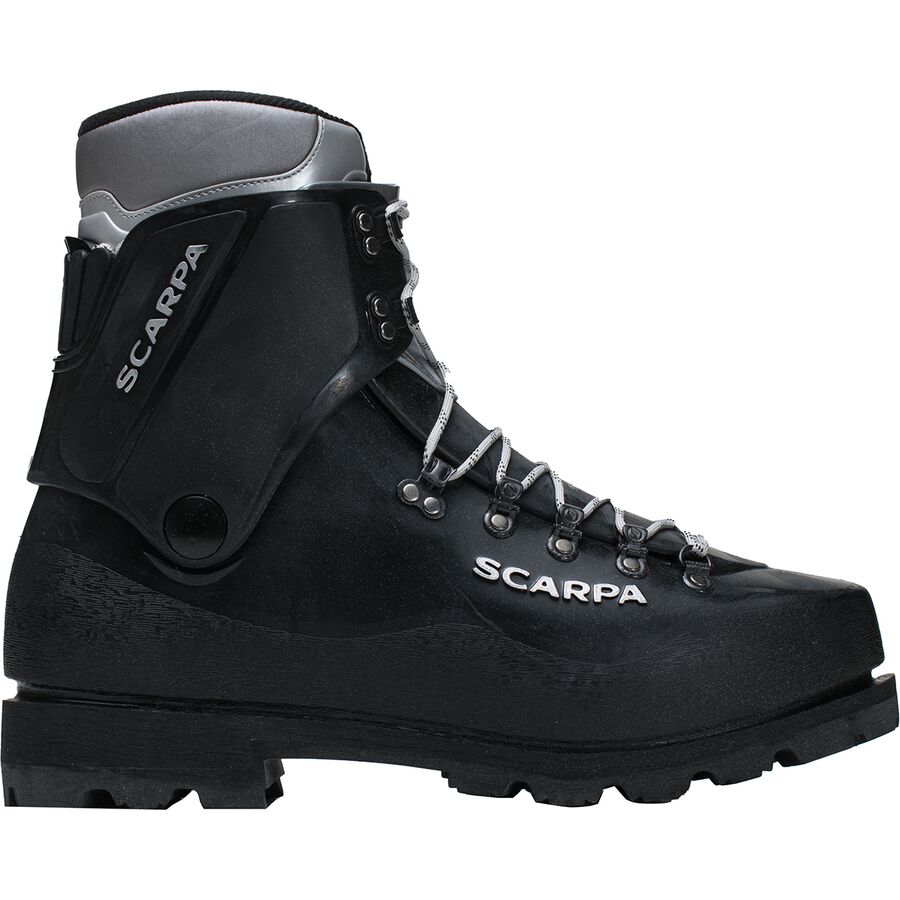
These boots are monsters; weighing in at 2.5 lbs per boot, a lot of weight on your foot. Inside is a foam liner that slides into the hard plastic shell. For a comparison, these were just a bit lighter than a modern ski boot.
The decision was made to call it a day because of the high exposure and avalanche risk. We loaded our packs up and off the back we went; into perfect bowls that made me miss my skis more than ever. A few hours later we had made it back to the glacier; it was just after 1000.
We were all looking forward to camp and relaxing, but we marched on toward the crevasses. Apparently, not everyone had done all three roles, so we were going back. From on the ridge, it looked like I could have thrown a frisbee and reached the crevasse field. But looks can be deceiving, and there was no way I could have thrown something three and a half miles. By the time we got there, it was just after 1300 and we were spent. I volunteered to be first to catch the fall. This time, I was the one thrown 5 feet forward before I was able to plant my ax and catch the fall. I then helped coach my team member as I held the weight of the 'fallen' climber. We returned to camp; it was 1700 and we had the rest of the evening off.
The Long March Ahead
At this point in the trip, we had learned enough that the instructors asked for volunteers to be leaders of the day. Stig and I thought it would be better to get it over with, so we were put in charge of the next day's activities. The instructors showed us our map location and where the plane was going to pick us up. We had almost complete control over what route the team would take as we determined the day's travel.
We would either go to the right of the crevasse field, or to the left, then on toward the pick-up point. By looking at the contour lines along where we wanted to go, we were able to get an idea of how long it would take to travel ground with similar traits. We learned from our summit day that travel was easier in the early morning when the sun had not yet melted the snow. By the end of tomorrow, we hoped to be at the the last major glacier, setting up the following days' leaders in an ideal position to escort us out.
Soon after we finalized our plans, Jeff approached us with the news that Matt was not feeling well and asked how we should proceed. Stig suggested we wait and see how he was doing later, no reason to shake things up at this point. Matt did not get better. In the interest of the team, Stig and I agreed to have the next be non-travel, giving Matt the best chance to recover. Jeff helped Matt, who vomited most of the night. Matt's tent group went about deep-cleaning as much of their gear as possible so they did not get sick.
Stig and I arranged for a couple of skills classes to be held so the day was not wasted. We both felt that it should be up to the team as to whether or not this counted as our day to lead, or would we get another chance tomorrow.
The group decided we could lead the following day. After a few revisions to the original plan, we decided to start at 0400 and travel for what we thought would be 6 or 7 hours. We planned to reach the last major glacier at the end of the day. Because we had moved over this terrain a handful of times already, we knew what the contours looked like and how fast we would travel. All that said, we made what turned out to be an accurate guess to the distance we covered that day.
'Bright' and early, we started our march onward, hoping to cover as much ground before 0715 when the sun would start to come up and hit the snow. We planned to travel up the same route that we had covered twice already, over a small rise, across a couple of bluffs, and drop down onto the glacier by the end of the day.
We made good time. We set up camp by 1430, having covered just under a quarter of the remaining distance from there to the evac point. At the CHAI meeting that night, we were given feedback from our fellow students and instructors. I learned more about leadership on that day than the previous five years combined. Our responsibilities ended when we passed the map and compass off to the next day's leaders. We crashed hard, knowing once again we'd have an early start time. Tomorrow's plan was to drop to the glacier and begin the ascent toward the summit of the last major obstacle of the journey: Jubilee Mountain.
After making record progress down the glacier the next morning, the leaders were in a bit of a dilemma, unsure where to take us next. The maps that we had showed glaciers running right to a large snow ramp leading into to camp. However, we found ourselves at the end of the glacier with no snow ramp in sight.
It was an hour before we started moving again. We climbed another 1000 vertical feet and crossed one more stream that was a little deeper then we thought. It didn't soak our feet too bad, and up for another hour or so, we soldiered on until we reached a flat area and set up camp. Despite the length of the past two days, in which we covered more miles than any previous week, we all felt good. Things were starting to become second nature. No longer did it take an hour to set up camp, but 20 minutes. We found our rolls and prepared them without being asked or told. We were becoming a team.
By now we knew what lay ahead of us: one large climb, followed by a larger descent. That day's leaders received feedback at the CHAI meeting. The new leaders presented us with their plan for the next and off to bed we went. Spent with plans, the next morning we'd travel up and over the second to last ridge that would take us to civilization.
Ghosts in the Night
The storm blew up and over the ridge, it's cold fingers trying to tear the tent from the surface. Out of the storm's fangs walked Jorn, in his orange jacket, leading a rope team toward safety. Instead of going toward the tents, his head swung as if looking for something, then he turned back into the mist away from camp.
That night was loud, but none of us cared. Two of our group heard noises and looked outside. They saw Jorn all roped up. He approached his tent and shook it. Mandeep looked out and made a happy sound, then disappeared back inside. The next morning there was a pleasant, energetic vibe throughout the camp; one which had not been present in a long time.
I overheard a conversation in my sleepy state and and this is when the 'dream' above occurred. In an effort to be efficient, NOLS had three Waddington Range trips planned for the summer with the same drop off and evac points for the group. The first group, WAD 68 (our trip), would be picked up by the same planes that would drop WAD 76 for their start. There was one trip between us working it's way up what we considered backward. It was their lead instructor that Grant and Nial had seen in the night. They recognized the instructors tent and said hello before leading their group down the ridge for the night.
Word quickly spread that another group had passed us in the night. We were interested to see them and hear of any news from the outside world. Our instructors warned us to not say to much about the trip ahead so we didn't spoil it for them.
It must have been truly terrifying to see a dozen different people running down the ridge still shrouded in mist, yelling at the top of their lungs; some of them physically recoiled. We asked about the basketball game Chase had wanted to know about all trip, among other things. Chase's team did in fact win. He was thrilled. It became clear that they wanted very little to do with us and we retreated up the ridge to our camp.
The SLOD's decided we were not to move that day because of the weather. We had another day to kill; turned out to be two days without movement. I caught up on sleep, dozing in and out for the next 48 hours. But we had information about the other side of the pass and hoped to find the tracks from the descending group to lead us up and over the saddle.
I thought a lot about the group we had encountered. They did not seam to have meshed like we had during our first week or so. Cliques were everywhere, and while we might have come across as a dysfunctional family, they gave a vibe of civil friction and disagreement. Our struggles had brought the group closer, but I was unsure if they would get the same result.
At CHAI, it was decided that the group would move tomorrow, just two days after the ghosts in the night. No one wanted additional stress on the group if we missed the evac for unnecessary reasons.
The red tent fabric fighting against the wind, rain, and slight. Warm Qdoba and pizza. The overwhelming urge to have coffee at all costs. The slight odor from my equipment, slipping down the dark hole into the arms of counterfeit peace...
Blinking, I looked at my watch: two minutes before my alarm rang. A curious habit I had acquired, where my body would wake me up minutes before my alarm rang. I lay there thinking that this journey would be over in a week's time; how I had waited so long for that moment, and yet, as it drew near, I was dreading it. Regardless of my feelings, I had no power over time. It slipped around our tent like the Enterprise jumping into warp, leaving crystals of herself in the past.
Knowing what I know now, I would not have slept well that night. There would be a time of testing in what we thought would be our final three days of travel. The physical battle had been won. The more sinister battle of the mind was marching toward us with the cold dawn of the next morning.
Z
We reached camp by 1700, cutting our travel time down to an hour and a half. At our CHAI meeting that evening, we went over the route for the peak ascent. It sounded like it would be about a six mile round trip. We were to bring layers for a day and a 'lunch'. With plans laid, we made dinner and crashed early. We would have a morning start time of 0430 in an attempt to climb one of the surrounding peaks. Time to get to bed.
The sky was so clear when we woke up! Someone had made a bowl that's edges were surrounded by mountains, and stretched over their top was a dark blue/black canvas. A gentle yellow glow illuminated the western edge of the bowl, and an inky blackness with bright pin pricks of stars could be seen in the east. It was beautiful.
Soon we were off, making good time across the two mile glacier that lay between us and the mountain. Most of the previous glacier time on this trip had been spent spent looking at my feet marching to whatever pace was being set, placing my boots in the impressions that were left from the person in front of me. This morning, there were no boot prints. The five inch layer of snow that had slowed our pace on previous days was still frozen with no tracks being made. We covered two miles in just over 40 minutes.
We took a break at the bottom of the mountain and looked up at the last mile before the summit. The elevation gain tripped for the remaining of the climb. Mandeep's team led, with Mandeep kicking steps into the firm snow and working his way up. During our time in S'whack Academy, our boots were heavy weights which were cumbersome and slowed us down. Now, they were tools to kick steps into the snow, their defined edges allowing us to break the surface of where we traveled.
The ideal step was called a bucket step. One would stand perpendicular to the hill and kick as hard as possible, sinking the boot just past the arch and compressing the snow, creating a step. Another form was called edging, where the climber would stand parallel to the face and kick the boot into the snow, sinking the uphill side of the boot into the surface, ideally setting the uphill half of the boot in the snow.
These boots are monsters; weighing in at 2.5 lbs per boot, a lot of weight on your foot. Inside is a foam liner that slides into the hard plastic shell. For a comparison, these were just a bit lighter than a modern ski boot.
As it turns out, in this terrain, maps are more or less just a reference. There were many times when we stood waiting for Mandeep's team to find a path through; our waiting was always rewarded. Credit to Mandeep: to my recollection, he lead almost every major face that the group encountered. Not that Jorn or Jeff couldn't have led; Mandeep just volunteered. "It be that way sometimes."
Up we kicked, making good progress. The sun started to peek over our bowl's edge. It spilled red, yellow, orange, and dark purple paint across the stretched canvas. We were soon on the saddle looking at our spoils. It was amazing. Most of the group were taking photos of the vistas, yet Jorn's camera, which he had carried the entire trip, remained in its protective case.
When asked about it, Jorn answered, "This is no different than any of the other times I've been here. It all looks the same to me." Being from Colorado, I could see how vistas could look the same, but I was never bored with the view. Jorn seemed to be bored. His reaction stunned me.
The decision was made to call it a day because of the high exposure and avalanche risk. We loaded our packs up and off the back we went; into perfect bowls that made me miss my skis more than ever. A few hours later we had made it back to the glacier; it was just after 1000.
We were all looking forward to camp and relaxing, but we marched on toward the crevasses. Apparently, not everyone had done all three roles, so we were going back. From on the ridge, it looked like I could have thrown a frisbee and reached the crevasse field. But looks can be deceiving, and there was no way I could have thrown something three and a half miles. By the time we got there, it was just after 1300 and we were spent. I volunteered to be first to catch the fall. This time, I was the one thrown 5 feet forward before I was able to plant my ax and catch the fall. I then helped coach my team member as I held the weight of the 'fallen' climber. We returned to camp; it was 1700 and we had the rest of the evening off.
The Long March Ahead
At this point in the trip, we had learned enough that the instructors asked for volunteers to be leaders of the day. Stig and I thought it would be better to get it over with, so we were put in charge of the next day's activities. The instructors showed us our map location and where the plane was going to pick us up. We had almost complete control over what route the team would take as we determined the day's travel.
We would either go to the right of the crevasse field, or to the left, then on toward the pick-up point. By looking at the contour lines along where we wanted to go, we were able to get an idea of how long it would take to travel ground with similar traits. We learned from our summit day that travel was easier in the early morning when the sun had not yet melted the snow. By the end of tomorrow, we hoped to be at the the last major glacier, setting up the following days' leaders in an ideal position to escort us out.
Soon after we finalized our plans, Jeff approached us with the news that Matt was not feeling well and asked how we should proceed. Stig suggested we wait and see how he was doing later, no reason to shake things up at this point. Matt did not get better. In the interest of the team, Stig and I agreed to have the next be non-travel, giving Matt the best chance to recover. Jeff helped Matt, who vomited most of the night. Matt's tent group went about deep-cleaning as much of their gear as possible so they did not get sick.
Stig and I arranged for a couple of skills classes to be held so the day was not wasted. We both felt that it should be up to the team as to whether or not this counted as our day to lead, or would we get another chance tomorrow.
The group decided we could lead the following day. After a few revisions to the original plan, we decided to start at 0400 and travel for what we thought would be 6 or 7 hours. We planned to reach the last major glacier at the end of the day. Because we had moved over this terrain a handful of times already, we knew what the contours looked like and how fast we would travel. All that said, we made what turned out to be an accurate guess to the distance we covered that day.
'Bright' and early, we started our march onward, hoping to cover as much ground before 0715 when the sun would start to come up and hit the snow. We planned to travel up the same route that we had covered twice already, over a small rise, across a couple of bluffs, and drop down onto the glacier by the end of the day.
We made good time. We set up camp by 1430, having covered just under a quarter of the remaining distance from there to the evac point. At the CHAI meeting that night, we were given feedback from our fellow students and instructors. I learned more about leadership on that day than the previous five years combined. Our responsibilities ended when we passed the map and compass off to the next day's leaders. We crashed hard, knowing once again we'd have an early start time. Tomorrow's plan was to drop to the glacier and begin the ascent toward the summit of the last major obstacle of the journey: Jubilee Mountain.
After making record progress down the glacier the next morning, the leaders were in a bit of a dilemma, unsure where to take us next. The maps that we had showed glaciers running right to a large snow ramp leading into to camp. However, we found ourselves at the end of the glacier with no snow ramp in sight.
It was an hour before we started moving again. We climbed another 1000 vertical feet and crossed one more stream that was a little deeper then we thought. It didn't soak our feet too bad, and up for another hour or so, we soldiered on until we reached a flat area and set up camp. Despite the length of the past two days, in which we covered more miles than any previous week, we all felt good. Things were starting to become second nature. No longer did it take an hour to set up camp, but 20 minutes. We found our rolls and prepared them without being asked or told. We were becoming a team.
By now we knew what lay ahead of us: one large climb, followed by a larger descent. That day's leaders received feedback at the CHAI meeting. The new leaders presented us with their plan for the next and off to bed we went. Spent with plans, the next morning we'd travel up and over the second to last ridge that would take us to civilization.
Ghosts in the Night
The storm blew up and over the ridge, it's cold fingers trying to tear the tent from the surface. Out of the storm's fangs walked Jorn, in his orange jacket, leading a rope team toward safety. Instead of going toward the tents, his head swung as if looking for something, then he turned back into the mist away from camp.
That night was loud, but none of us cared. Two of our group heard noises and looked outside. They saw Jorn all roped up. He approached his tent and shook it. Mandeep looked out and made a happy sound, then disappeared back inside. The next morning there was a pleasant, energetic vibe throughout the camp; one which had not been present in a long time.
I overheard a conversation in my sleepy state and and this is when the 'dream' above occurred. In an effort to be efficient, NOLS had three Waddington Range trips planned for the summer with the same drop off and evac points for the group. The first group, WAD 68 (our trip), would be picked up by the same planes that would drop WAD 76 for their start. There was one trip between us working it's way up what we considered backward. It was their lead instructor that Grant and Nial had seen in the night. They recognized the instructors tent and said hello before leading their group down the ridge for the night.
Word quickly spread that another group had passed us in the night. We were interested to see them and hear of any news from the outside world. Our instructors warned us to not say to much about the trip ahead so we didn't spoil it for them.
It must have been truly terrifying to see a dozen different people running down the ridge still shrouded in mist, yelling at the top of their lungs; some of them physically recoiled. We asked about the basketball game Chase had wanted to know about all trip, among other things. Chase's team did in fact win. He was thrilled. It became clear that they wanted very little to do with us and we retreated up the ridge to our camp.
The SLOD's decided we were not to move that day because of the weather. We had another day to kill; turned out to be two days without movement. I caught up on sleep, dozing in and out for the next 48 hours. But we had information about the other side of the pass and hoped to find the tracks from the descending group to lead us up and over the saddle.
I thought a lot about the group we had encountered. They did not seam to have meshed like we had during our first week or so. Cliques were everywhere, and while we might have come across as a dysfunctional family, they gave a vibe of civil friction and disagreement. Our struggles had brought the group closer, but I was unsure if they would get the same result.
At CHAI, it was decided that the group would move tomorrow, just two days after the ghosts in the night. No one wanted additional stress on the group if we missed the evac for unnecessary reasons.
The red tent fabric fighting against the wind, rain, and slight. Warm Qdoba and pizza. The overwhelming urge to have coffee at all costs. The slight odor from my equipment, slipping down the dark hole into the arms of counterfeit peace...
Blinking, I looked at my watch: two minutes before my alarm rang. A curious habit I had acquired, where my body would wake me up minutes before my alarm rang. I lay there thinking that this journey would be over in a week's time; how I had waited so long for that moment, and yet, as it drew near, I was dreading it. Regardless of my feelings, I had no power over time. It slipped around our tent like the Enterprise jumping into warp, leaving crystals of herself in the past.
Knowing what I know now, I would not have slept well that night. There would be a time of testing in what we thought would be our final three days of travel. The physical battle had been won. The more sinister battle of the mind was marching toward us with the cold dawn of the next morning.
Z
Subscribe to:
Comments (Atom)